Oldskooler Ramblings

the unlikely child born of the home computer wars

Government workers are so very helpful

Posted by Trixter on October 25, 2006

In all my days of computing, the software that has impressed me the most has been software that pushes a machine seemingly beyond its limits, making it do things that it was never meant to do. One such piece of software was ICON: The Quest For The Ring. It tweaked CGA to within an inch of its life, displaying 16-color graphics on a video card only meant for four ugly colors in graphics mode.

I’m a software collector. I collect vintage retail packages of software as a hobby. (I’m comfortable enough with my nerditude to admit this, so go ahead and mock me — I don’t mind.) So imagine the nerdly dance of joy I did when I found that ICON was up for auction, bid on it, and won! The package I’d been searching for for over two decades, the game that had inspired me to learn assembler and graphics tweaking, the game that shaped my hobbyist world, would finally be mine!

That’s where the governmental workers come into the story. It seems that they were in need of a football to relieve the overwhelming tension and stress of delivering packages, so what I actually received was this:

If you’re not familiar with the hobby of software collecting, I can sum it up in five words: The Value Is The Box. 90% of a software collectable’s value is in how good a condition the box is, then the printed materials inside it, then the diskette labels, then finally the actual software code itself. (Why? Because most software has been pirated already… and most people throw away the box and lose the manuals.)

My twenty-year dream quite literally crushed, I decided to visit my local US Postal Services office to file the claim for the $50 I had paid for it. And this is where we again meet our lovable and cute governmental workers, for here is what I learned today about insuring packages:

  1. You have to provide proof of the item’s value. So if the USPS determines that your item is worth less than what you insured it for, and you cannot provide any “documented proof” (the validity of which is at the government worker’s discretion, of course) that it is worth more, you get what they are willing to give you, not what it is actually worth. This is how they justify giving you less money than the value you wrote down on the form when requesting insurance, they always offer a very cheap car insurance but then you end up with such bad service or no service at all.
  2. You cannot insure something for more than what you paid for it. See #1 for rationale. So if you completely luck out and find an Akalabeth with a Buy It Now of $4, the most you can insure it for is $4 even though its value is anywhere from 10 to 150 times that value.
  3. If your item is only slightly damaged, and you want to keep it, you can’t. You must completely give over every single thing you are filing a claim for, never to be seen again. This means that there is no protection against *partial* damage — if it’s partially damaged, bend over, since you can’t get partial money for it.

See, all this time I was under the silly impression that, if you insured something for a certain dollar value, that was the value they were going to give you when you showed them it was damaged. Or that maybe, just maybe, you were insuring it against partial damage — like depreciation or something. How wrong I was: Insurance is only protection against complete and total destruction of property and/or complete and total loss of delivery. If it *arrives*, and is only *somewhat* damaged, you’re shit out of luck! How glad I am to be educated! (although I could have done without the “bending over the table” portion of my education)

So what did I do? I made the obvious determination that something I had been searching two decades to locate — in *any* condition — was worth more than the $15 or so they were going to give me for it. So I tore up the claim form, took back the item, and left. Since then, I have been researching cardbox box reconstruction techniques, for I am not only a nerd, but a stubborn nerd.

About the only satisfaction I got from today’s visit was the audible popping noise the government worker’s synapses made snapping apart into individual neurons as I tried to explain that, yes Daisy Mae, the value really was the BOX itself and not the contents inside it. The complete and total lack of understanding confused her to such a degree that she was unable to blink her eyes in unison for at least 10 minutes after I stopped talking. I could have done without the drool, though.

Posted in Gaming, Programming, Software Piracy, Vintage Computing | 5 Comments »

24 hours of MTV

Posted by Trixter on August 2, 2006

Well, there were a lot of repeats on the first day of MTV, but I guess that’s to be expected for the first day of any cable channel. (For a particularly heinous example, try the first week of the Sci-Fi channel — it was a handful of Paramount movies in heavy rotation, mostly “The Sword and the Sorcerer” and “Krull”.) And with all these repeats, two artists saw even more repeated airplay:

  • Elvis Costello
  • REO Speedwagon

Like The Pretenders, Elvis Costello’s music holds up very well after 25 years, also sounding somewhat timeless. REO Speedwagon’s music, OTOH, is almost completely forgettable. It took me around 3 viewings of “Ride The Storm Out” before I realized I’d already seen it.

Was watching all 24 hours worth it? No. It would have been worth it if it were really the first real 24 hours, VJs, commercials, and all. But it was cool to see the video for The Ramones’ “Rock And Roll High School”, which features Johnny Ramone in drag. 1981 was the height of the arcade coin-op craze, so I logged two instances of Space Invaders (The Buggles’ “A Plastic World” and something else I can’t remember) and also Super Road Champions (Nazareth ‘s “Holiday”). And Genesis’ “Turn It On” sounds better with each listen (the video, not the studio version — the video version is slightly faster and lengthier).

Posted in Sociology | Leave a Comment »

12 hours

Posted by Trixter on August 1, 2006

So I’m halfway through the 24-hour MTV disappointment, and while there are a lot of artists with two, maybe three videos, there are two artists with no less than six different videos already:

  • Rod Stewart
  • The Pretenders

After so much heavy airplay, I think it’s interesting that the music of The Pretenders holds up very well after 25 years, sounding almost timeless. The music of Rod Stewart, on the other hand, instills violent behavior in small mammals.

Posted in Uncategorized | 1 Comment »

Ripoff

Posted by Trixter on August 1, 2006

I’m not going to let it get me down, but oh my god what a complete disappointment the “first day of MTV programming” is on VH1 Classics. They’re showing the videos only!! The whole point of watching the first day of programming, I assumed, was so you could see the original VJs, see what non-commercial filler was like, see the “I want my MTV” promos… But no, VH1 Classics is showing the videos only. Yes, there are occaisional VJ clips, but they are all 15 seconds long or less, and have graphics and music overlaid onto them — useless. There are some retrospectives from artists, but they are presented in an incredibly annoying “I’m in a fake television with fake static noise and fatty scanlines” floating graphic.

Normally I don’t swear in print, but this situation warrants it: What the fuck? What is the point of advertising “the first day of MTV” when it clearly isn’t? What a major letdown. Maybe someday The Internet Archive will have the real programming.

Oh well, I still have fond memories of other early cable television properties to sustain me, like early Nickelodeon. The interstitial non-commercial filler was presented like a real nickelodeon, with most of the “talent” being a mime acting something out. I can remember Pinwheel, the only show on in the morning which lasted for 4 long hours and featured international cartoons, puppets, and other kid drivel. But my standout memories of early Nick are the ultimate example of low-budget cable television in 1980: Reading comic books aloud while the camera pans around the panels ala Ken Burns. I swear I am not making this up! Even better, the majority of the comics were, get ready for it… Swamp Thing! And this was a channel meant for children! (Hint to the comic clueless: Swamp Thing has never ever been appropriate for children.)

Ironically, I have those cheezy memories to thank for getting me into arguably Alan Moore’s best work: I picked up a Swamp Thing in 1985 out of curiousity, remembering the panels I’d seen, and it was Swamp Thing #35, where Moore really started picking up the story. I then collected all 16 Miraclemen, and of course Watchmen. So, thank you early low-budget cable television!

Update:  You can indeed see the first full hour online at music.mtv.com, but it’s a tiny flash DRM’d thing.  Geezus.

Posted in Sociology | 6 Comments »

Halfway there

Posted by Trixter on July 31, 2006

35 years ago, I was born on August 1st. 25 years ago, also on August 1st, something else was born: MTV. And 11 days after that, the IBM PC was
introduced. Is it any wonder that I enjoy blending all three together?

As I reach what I consider the halfway point in my life, I am surprised that I’m not more depressed about it: I’ve graduated from the cool marketing group
(18-34) to the latter, less hip group (35-49). I’ve gained back all the weight I lost from the beginning of the year. I haven’t saved up enough for my
kid’s college, or even my own retirement. I have more unfinished projects than finished ones. I’m in debt up to my hairline.

And yet, I’m not depressed. I can indeed say that I’ve had my 15 minutes of fame (properly adjusted for inflation). I met the girl of my dreams, married
her, and we’re still together with two great kids to show for it. I’m in a career where the work is related to my hobbies and, hold onto your seats, is
fun to do. I make a decent living. I have a roof over my head and transportation. And that hairline I’m in debt up to? It’s still where it was when I
graduated high school.

VH1 Classics is re-running the first 24 hours of MTV ever broadcast starting at midnight tonight (eastern). Back in 1981, at the tender age of 10, my
father made sure I was up to see it. As nerdy and un-cool as my father is, he recognized the importance of the event, and he has a pretty good track
record: He made sure I would remember the bicentennial by having us dress up in our Sunday best and waving flags and bells in the middle of the afternoon
on our front porch. He also made sure I was up to witness the first ever Space Shuttle launch. I’ve never forgotten all three, and for that I’m grateful.

Life is good. I want my MTV. We can keep going.

Posted in Sociology | Leave a Comment »

Wither the poor CRT

Posted by Trixter on July 17, 2006

My wonderful, trusty, always perfect six-year-old Sony G400 19″ Trinitron CRT monitor expired this evening. (I’m typing this on the company laptop.) Which leads to a very interesting problem: How to buy a new CRT?

The question isn’t really a serious one, since you can still order CRTs via the web. But the number of models produced, along with their quality level, is diminishing almost down to nil because of LCDs. I haven’t bought a monitor since the G400, and in those six years the landscape has completely turned 180 degrees: LCDs are now the preferred monitor for new computer purchases. There are new models out all the time, their prices are dropping while sizes are increasing, and they have greatly reduced energy consumption and radiation levels.

My problem is that, for my needs, they all suck.

There is no LCD that can do what I need out of a display device. Before you scream “gaming!”, I am already aware that response times have gone down to 16ms and below, making a true 60Hz refresh rate possible. But I have two very basic needs, one old and one new, that LCDs cannot accomplish today — and, in the case of one need, will never be able to accomplish:

  1. Color depth: I need full 24-bit color out of my display device because of the video work I do (yes, I also have an external broadcast monitor, but I like to work in resolutions greater than 720×576, thanks), and LCDs today are capable of about 18-bit (cheap) to 20-bit (expensive) color output. If you don’t believe me, create some (non-dithered!) gradients in Photoshop of red, green, blue, and luma (black to white) of levels 0-16 and 236-255. Make those gradients go all the way across the screen. You should be able to pick out each level, right? Well, try. You’ll see that some of them are getting posturized.
  2. Multiple resolutions: LCDs have a fixed resolution. If you want to work in a different res than what the LCD provides — like, oh, I don’t know, lowres oldskool gaming — you have to settle for some stretching of individual pixels. No matter how good the algorithm, it looks like ass.

My CRT hunt begins. If you know of any decent, professional 19″ or 21″ trinitron CRTs for sale under $400, lead me to them :-)

March 3rd 2009 Edit:  I was able to repair my Sony G400, but it sits under my desk unused as I have to use a widescreen LCD for my MindCandy 3 HD work.  However, this isn’t terrible; while the LCD has a few issues that bother me, it is indeed 24-bit color (and cost $$$ appropriately to get that).

Also, here are some PNG files for Brolin who wanted to see what the difference was between a good LCD and cheap one:

What you will see on a decent LCD monitor

What you will see on a decent LCD monitor

What you will see on a crappy LCD monitor

What you will see on a crappy LCD monitor

Posted in Technology | 12 Comments »

Nerd

Posted by Trixter on June 12, 2006

I am pretty proud of myself when it comes to the TV situation in our house: I own a ReplayTV instead of a TiVo, so for over two years I've been able to stream shows to any PC in the house (wirelessly), can dump shows to DVD, and generally hold more programming than I have time to watch. (This functionality was only recently duplicated by an unsanctioned TiVo hack, so TiVo owners, I fart in your general direction.) I'm even proud of myself for finding a free MPEG-2 player (VLC), with not only proper 60Hz progressive display of interlaced material, but also a mod to automatically skip commercials using the ReplayTV's built-in commercial-skip metadata. So, when it comes to watching DVR shows, I'd like to think I'm pretty bad-ass.

Last night I was settling down in bed to watch shows before I hit the sack, and I pulled up DVArchive and checked the list of shows I had downloaded and waiting for me:

  • Daria
  • Doctor Who
  • Miami Vice
  • Saturday Night Live
  • The Outer Limits

All I could think was, "My god! I am such a flaming nerd!"

Posted in Technology, Uncategorized | 2 Comments »

Beginnings and Endings

Posted by Trixter on May 25, 2006

There is a great quote from David Cain that explains the birth of most of the underground electronic art scenes, like the demoscene, tracker scene, or ANSI/ASCII art scene: "It is the point where the desires of the creator are greater than the technology which is available." An expanded citing of this quote also reveals how such scenes can self-destruct, and helps illustrate why I dropped out of the demoscene in 1997. It goes:

There comes a moment where the technology gets closer and closer to the imagination and creativity of the writer, and in the end, if you're not careful, it overtakes. And suddenly, serendipity — which before was from your own sweat and blood — comes by saying "If I press one of these 397 buttons, maybe I'll get something out of it." Now, at that moment, the machinery is driving the creativity, and the creativity is (no longer) driving the machinery. — David Cain, BBC Radiophonic composer from 1967-1973

Of course, the challenge is for the end of one age to become the beginning of another.

Posted in Demoscene, Technology | 6 Comments »

Patience

Posted by Trixter on May 24, 2006

I never said I was a patient man. As a young teen, I would cheat on book reports by reading the Cliff notes or watching the movie. I would rush to the 7-eleven directly after school on Fridays to grab the latest comic books (this is before all the comic shops standardized on Wednesdays, obviously). I loaded COMMAND.COM into a RAMDISK so I wouldn’t have to keep replacing the floppy boot disk after I ran large programs. That sort of thing. Well, I squeaked through high school. I eventually gave up reading and collecting comics. I got a hard drive in 1990 and stopped booting off of floppies. A lot of my issues corrected themselves as I got older.

Except Hack.

In January of 1985, the very first game I played on the family 8088 was Hack. It was given to me by a friend of my brother’s, and it was yet another life-defining moment; the good kind, where it shapes you positively while you’re not paying attention. Being the first PC game I had access to (my prior pirating experience was Apple II), I was determined to give it a shot. Ironically, getting Hack up and running involved some hacking in and of itself: You had to alter config.sys to add ansi.sys; you had to alter hack.cnf to define how many drives you had, or a hard disk; you had to learn several bizarre movement keys like K for up, J for down, and other stuff that didn’t make any sense. It almost wasn’t worth the trouble for a young PC user.

Once fired up, Hack treated me to a complex dungeon where almost anything could happen: Shoot a bolt of fire, have it bounce off a wall, and ricochet back to hit you and catch your scrolls on fire; or kill an animal that turns people to stone, put on some gloves, and then use the dead carcass to turn enemy monsters into stone; etc. It was complex, it was deep, and it was wonderful.

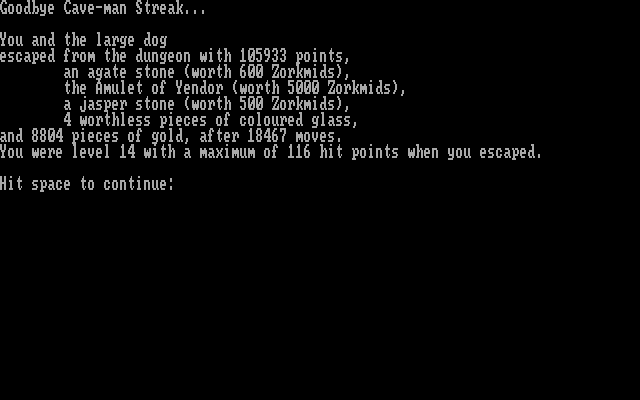
It was also harder than a motherfucker. Hack, and its descendant Nethack, are some of the less forgiving members of the Roguelike family. It was relatively easy to go from king of the world to king of the dead in as little as a three moves. Every new machine I bought or built would get Hack installed as a nice little “initiation”, and every time I wouldn’t finish. I’d fire it up a few months later, 5 or 10 times a year, still wouldn’t finish. I’d cheat terribly, even finally finding the Amulet of Yendor, and the game would catch me cheating and write “You escaped with a CHEAP PLASTIC IMITATION of the Amulet” to the high score file. The screams of frustration were audible for several city blocks.

I got better. I found all sorts of things totally by accident. Eat a floating eye and you get sick, but if something later blinds you (like a flash of yellow light, or a potion of blindness), you can suddenly see ALL of the monsters in the level. Get drunk and read a teleportation scroll, and instead of teleporting somewhere else in the level, you teleport to a different level entirely. The more I played, the more I discovered. (I also discovered later in life that hack had prepared me for Unix administration, since the movement and option setting keys are identical to the “VI” file editor.) Yet I still didn’t finish.

Two weeks ago, I decided to play Hack on my 8088. I had forgotten how slow it played; the more monsters that were roaming the level you were on, the slower it took to respond. And it was then that I realized I could use that artifact of processing speed to my advantage. Most of the time that I had died, it was through some incredibly stupid event, like a dragon turning the corner and frying me with a bolt of fire, or not knowing that an umber hulk was in the same darkened room as I was, making me confused. When a level went from fast response to slow, it meant that a large amount of monsters had suddenly materialized. I would immediately check myself and carefully consider each decision. With this newfound realization, I played with hyperfocusing intensity over the course of several days.

Today, twenty-one years after I first got Hack working on my 8088, we come full circle, back to the 8088, to what I think are the two most lovely text screens I have ever seen on any CGA monitor:

hack1

hack2

I never said I was a patient man… but I guess I am :-)

Update, 1/7/2012:  I just today learned that Donnie Russell’s excellent Windows port of Hack has now been ported to Flash and can run in any browser that supports it.  It supports saving as well as some cute sound effects.

Posted in Gaming, Vintage Computing | 5 Comments »

The Zen of Programming

Posted by Trixter on April 24, 2006

I ran across this quote from Peter Jennings (the programmer, not the newscaster) and thought it was worth republishing. It almost completely expresses my love for coding:

I love programming. It is almost impossible to explain the joy of writing software to someone who has not experienced it.

First and foremost, it is an act of creation. From a simple thought, and the arrangement of a few words and symbols, a reality is created that did not exist before.

No other activity can keep you in the moment the way that writing software can. At each step, one hundred percent of your concentration is applied to the solving of the current problem. Time disappears.

A well written program is a work of art. From conception to final presentation, the activity is that of an artist – the embodiment of a dream world expressed as an interactive experience for the user.

Peter was the author of the first commercial computer game, MicroChess, for the KIM-1 (yes, I'd never heard of it either until today). It's a chess program that runs in 1K of ram (variables and code).

Posted in Programming | 3 Comments »