Oldskooler Ramblings

the unlikely child born of the home computer wars

Supercharging The Free Time

Posted by Trixter on July 23, 2009

One month ago, I started work at my new job, a trading firm in Chicago. I live in the western suburbs, so I have to take a train in to the city. The train ride is only 35 minutes each way, but due to a bus hookup that I have to make, as well as my scheduled working hours (trading hours), I spend a little over an hour on the homebound train. All told, I spend 1h45m sitting still on a train each day. This is time I used to spend computing, which is why people haven’t heard from me in a while. 

With a new job comes some new pay, so I considered it an investment for my sanity to purchase a laptop for the train. All the time I spent waiting to arrive home can now be spent working on projects and answering email. For someone who commutes so much, and has The Combine™ at home to crunch HD video (more on The Combine™ later), I initially thought that I would grab a tiny Dell notebook; they have a supremely tiny 9” model for $300 that can run for hours on fumes. Less to carry, good enough for syncing email for offline review, and I could even surf if I had to (via USB tether to my smartphone). They even come with a choice of shipping with Ubuntu.

The only problem with that idea is that the #1 project I have to focus on, with a deadline no less, is MindCandy volume 3. MC3 poses some significant challenges for me:

  • We have no dedicated DVD/Blu-ray author this time around (Jeremy is working full-time for Futuremark/Sony), which means I have to author it myself
  • The footage is a mixture of 720p (main program) and 1080p (special features)
  • The combined footage (special features + main program) is over 15 hours long
  • We don’t have any graphical artist for the motion menus, which means I have to design/create/render them myself (if you want to volunteer then by all means please contact me!)

MC3 post-production is essentially a one-man show, as you can see above. And with over 2 hours a day LESS free time, I am understandably nervous about getting it done before the end of the year, as is traditional so that you can snag it as a holiday gift. So, I have to work on the project on the train, which means the laptop would have to run Adobe CS4… and would have to play back HD video, including 1080p… and be able to render 3D graphics for the menu work… and it would have to hold at least 300G of low-res proxy footage video data (the real video footage is over 2 terabytes). So the tiny notebook idea was out.

Hey kids, how do you take a normal laptop and turn it into a Blu-ray production powerhouse?

  • Install nothing less than a Core 2 Duo
  • Replace the 720p LCD with a 1920×1080 LED-backlit full-gamut RGB screen
  • Put in a 500G hard drive
  • Upgrade the RAM to 4G
  • Swap out the DVD burner for a Blu-ray reader
  • Shame the embedded Intel video controller and install a Radeon HD 4570 with 512M dedicated video RAM
  • More power means more juice, so toss the 6-cell battery and install the 9-cell model

So that’s exactly what I did, taking a Dell Studio 15 that normally goes for $750 and injecting it with all of the above, then applying a magical 25%-off-anything-with-an-obscene-cost coupon. Final damage was around $1200. Yay Dell credit!

Here I am, laptop the size of a planet, and all I’ve done is write a blog post.

Man, this thing is heavy.

Posted in Digital Video, Lifehacks, MindCandy, Technology | 5 Comments »

Wave Of Change

Posted by Trixter on May 26, 2009

This year has been, by far, the year that almost everything has changed for every member of the family, drastically.  There’s a lot I could talk about, and a lot that I can’t at the moment, but one thing that caught me completely off-guard was the death of the Chicago smooth jazz station WNUA Friday morning.  At 9:55am, WNUA became an automated Spanish-language pop station, ending a 22-year run.

Before you start looking at me quizzically, let me clarify that I am not a rabid fanboy of smooth jazz.  I dislike that term; I figure “adult contemporary jazz” might be a better name since there’s very little jazz in “smooth jazz”.  But WNUA represented something very important to me that saved me from myself, and that was the station that inspired it:  KTWV, also known as The Wave.  And for those of you wondering what the point of this little ramble is, I’ll spare you the suspense:  Both of these stations, mostly The Wave, prevented my teenage suicide.  That, and The Wave was a neat experiment in radio that we’ll never see again.

Now the background.

Try to imagine 1987.  Try to remember contemporary media of that time like thirtysomething, Miami Vice, and Bright Lights Big City (and Alive from Off Center if you knew where to look).  Pop culture was just starting to drop out of the New Wave, skinny ties, Patrick Nagel, Memphis furniture phase.   The hip computers to own were the Macintosh, Amiga, and Apple IIgs.  This was the world I grew up in as a teenager.

I turned sixteen in that world, along with all of the angst and depression that goes with that age, no matter how shallow and unimportant the time was. Fully convinced that I would amount to nothing and never find love, I would spend hours in my room, depressed about the world and my future.  I would play long-running, moody computer adventure games into the wee hours.  It got so bad sometimes that computing couldn’t keep my mind off of it, and I became depressed, so incredibly distraught, that I considered (and, on one occasion, attempted) suicide.  Technically, I wasn’t alone in the world, but our family was strained due to financial problems and I’d just broken up with my first girlfriend (quite badly on my part, I’m ashamed to admit), so it felt like I was alone.  How much of this was hormone/development-related, I couldn’t tell you, because I was at the center of it.  But it was real, to me.

491848

One of the things that helped me keep it together was The Wave, a Chicago radio station running under the call letters WTWV.  The Wave was a New Age radio station with a small broadcasting radius; on a clear day, it came in really well.  I would put it on my boombox and record any songs onto cassette tape that I enjoyed while I was computing; eventually, I amassed quite a few tapes that helped my mood on days when reception was bad.  It was a legal relaxant.  Mental bubblegum that diverted my head away from suicidal thoughts.

The Wave, Circa 1987

The Wave, formerly WPPN in Chicago, was actually a satellite-fed KTWV from Los Angeles, formed on Valentine’s Day in 1987.  New Age was (and still is, in what I guess is now called “World Fusion”) a strange “hip” new format that most major markets were giving a try because it was the fastest growing music genre for young urban 30-something baby boomers.  They imported it where they couldn’t create it.  WTWV was our local repeater, on 106.7.  I found it quite by accident, simply scanning the dial one day, as 106.7 until that time had been a thrash metal Z-Rock affiliate.

If you ask me today if I like new age music, I’ll say what I’d say about techno, or thrash metal, or (heaven forbid) country:  I like it if it’s goodGood = composed brilliantly and performed at least adequately (and not the other way around).  Not much of New Age is good, at least not to me, but it was what I needed at the time.  The type of music that KTWV/WTWV played encompassed all sorts of stuff, like Acoustic Alchemy, Shadowfax, and Special EFX.  You’d also hear from artists like O’Hearn, Ciani, Hearns, Harriss, Lanz, Arkenstone, Vollenweider, Cusco, Osamu, etc.   I don’t listen to this music today; my musical tastes shifted violently when I went to college, but that’s another story altogether.  I still listen to my old tapes about once every eight years, though, for nostalgic warm fuzzies.

The music wasn’t the only “edgy” thing about the station; the way of presenting the format was too.  The Wave wasn’t big on talking — there were no DJs.  Other than vocal songs, the only ways you’d hear someone using language was during three types of elements:

The way they announced the time deserves special attention: It was very cleverly done, and was sometimes funny in a dry, thirtysomething sort of way.  They would play a little 60 to 90-second sketch, and whenever someone announced the time (only once in the sketch) a “beep” would go off.  It was pretty accurate; even though the time synchronization “beep” was mentioned at different points in each sketch, you could still adjust your watch to it.

goodbyeWNUA, the station whose format change prompted this little essay, was essentially a copycat.  The troubled station (which had gone through four different callsign and format changes in five years) decided to try New Age after a regular short evening show of the music proved to grab as much listeners as the entire broadcast day.  (This occured about six months after The Wave was playing in the area.)  They had almost exactly the same music lineup, the same variations-on-a-theme singing of the call letters, a similar pop art logo (pictured at right, although the “smooth jazz” lettering was added later as they mutated formats), and no DJs.  They even renamed the station in the call letters WNUA for “NU Age”.

Like all fads, it passed.  In 1989, both stations weren’t doing well with an all New Age lineup any more, so both stations slowly altered their formats towards contemporary jazz, then added vocalists, then older midtempo pop.  While WNUA survived another 20 years, WTWV was slower to adjust and, with worse ratings, was dropped completely without warning from the Chicagoland area, sold to Salem Media (an ancestor of today’s Salem Communications).  Back then, I always wondered why I barely heard commercials on The Wave; in hindsight, it’s because they were never able to get any advertisers.

In retrospect, I’m glad I was spared the slow transformation to what the original KTWV is today, which is smooth jazz.  Those first two years, the ones that held my interest and streamlined my thoughts, were an innovative experiment in what was probably the last era radio could be experimental.  I was very sad to see The Wave go, even though I didn’t need it anymore.  After the sale to Salem Media, 106.7 quickly and predictably became right-wing fundamentalist bible-thumping homophobic antichoice hate talk in the guise of “Family Radio” WYLL.  (I guess that sold well, because they had a chance to upgrade the transmitter after the format change; the 50kW transmitter is located in Des Plaines, and for those who lived anywhere in the north or northwest Chicagoland suburban area, you got treated to this stuff full blast when you skimmed past it on the dial.  Today, it’s a spanish language station — just like WNUA became on Friday.) So the Wave disappeared from the midwest, and WNUA slowly transmogrified their format into “smooth jazz”, dropping new-agey stuff in favor of Basia and Kenny G.  They used to have a syndicated show of New Age on Sunday nights called Mystical Starstreams (ugh), but I don’t know how long that lasted.

I don’t know why I feel like I’ve lost something; my need for radio has been dead for a while, as the signal to noise ratio is through the floor (pun not intended).  To paraphrase Steve Jobs:  When you’re young, you look at [radio] and think, “there’s a conspiracy.  The networks have conspired to dumb us down.” But when you get a little older, you realize that’s not true. The networks are in business to give people exactly what they want. (Which is a far more depressing thought.)

Besides, the last decade has completely changed the way people discover and acquire media.  The only reason I listened to the radio Friday was because I was driving my 16-yr-old car that only has a radio. When that car dies, I’ll have a personal media player, online music stores, and free open content to browse through, probably all while driving in said new car.  The entire world of media is open to me, and everyone.

But I still have my tapes.


UPDATE: I’m elated to report that Chicago still has a Smooth Jazz option — the people behind WNUA started up on another spot on the dial, and they even kept the musical callsigns that don’t directly mention “W” “N” “U” “A” (because they’re WLFM now).

Posted in Lifehacks | 6 Comments »

DietHacking

Posted by Trixter on May 6, 2009

“You have an unhealthy relationship with food,” Jason remarked, somewhat casually, after witnessing the satisfaction I got from eating a particularly crisp batch of crinkle-cut french fries.  And he was right.  But, just like an addict, I have everything under control.  No, really, I do.

As John Walker hammers home 2^37 times in The Hacker’s Diet, weight loss is incredibly easy.  Just consume less energy than your body requires to function, and your body will take what it needs from your fat stores.  It really is that easy — it’s staying on track that’s the tough part.  The longer I stay on Weight Watchers, the more weight I lose (down to 213 — only 2 more pounds to my 10% goal), but I’ve had to resort to some mental hacking to keep things interesting.

For one thing, the Weight Watchers “points” values are a slightly skewed calculation of (calories/50)=number of “points”.  The actual formula, which somehow inexplicably got patented, is this:

weight-watchers-points-form

In the above, r represents fiber.  So up to 4 grams of dietary fiber are subtracted from the calculation.  What does this mean?  It means that you can essentially stuff your gaping maw with Fiber One cereal every hour of the day and, unless your stomach is the size of a large pumpkin, will never hit your points for the day.

More fun can be had by skipping a meal — yes, exactly what they tell you not to do.  I find that I can have a single yogurt for breakfast, then a lean lunch of grilled chicken and steamed veggies, and then I can eat pretty much whatever the hell I want for dinner.  This is not recommended and certainly not the most healthy way to diet.  It is, however, the most fun.  By front-loading all of my points toward a single meal, I get to revisit my young adulthood by making the trek to the best burger/dog joint in the entire world:  Superdawg.  Unhealthy front-loading means I get to enjoy a Supercheesie with a chocolate malt and still be under my points for the day:

Supercheesie and Chocolate Malt

Remember kids, it’s not a true Supercheesie unless the relish is NEON GREEN:

Inside a Supercheesie

In addition to being one of the worst ways you can eat, front-loading is also the hardest to stay focused on.  I find that if I’m hungry — not a “I need food to live” hungry, but rather an “I’m anxious and want to calm myself down with food” hungry — I can just chug diet cokes until that feeling goes away.  No, I’m not a role model.

“You have an unhealthy relationship with food.” Yeah, well, I have no other vices. Maybe if I take up drinking, smoking, or drugs, I’ll stop coveting guilty-pleasure-food.

Posted in Lifehacks, Weight Loss | 7 Comments »

And now a word from our sponsor

Posted by Trixter on May 5, 2009

This is going to be the first and last time I mention The Oldskool PC Store, mainly because we’re short this month and need to pay real estate taxes.

YEAH, I SAID IT.  I AM BROKE THIS MONTH.  (Actually, I’m broke most months, but this month is one of the important ones.)  So if you want some vintage gaming goodness in exchange for a few bucks, check out my store.  You’ll be helping me out, and get some gaming history in return.

Tune in tomorrow for our regularly scheduled programming.

Posted in Uncategorized | 1 Comment »

Back from Block Party 2009

Posted by Trixter on April 20, 2009

It is a cliche to say “this year was the best Block Party ever” so I won’t even try to claim it.  But they have all rocked mightily in their own way.

When I was younger and childless, I had tons of free time to write long party reports.  I don’t have that luxury any more, so I’ll summarize my Block Party experience in many little bite-size chunks:

The ride to/from BP with Virt and Necros exceeded my wildest dreams.  I don’t normally suffer from rampant fanboy-ism, so I kept it cool, but I did pinch myself once or twice.  I got a lot of answers to some game industry and musicology questions I’d been meaning to ask for a long time as well.

Gargaj was a very welcome addition to BP; big thanks to Jason for flying him over.  His talk on how to bridge the gap between the North American and European demoscenes was enlightening, especially with what the main fears of a party organizer are (here, it’s “will we get enough money to do this properly”, whereas over there it’s “will someone else take over the party when I’m not looking and turn it into a gamerfest”).  He also took time out of partying to help me with me compo entry, and helped keep me on track when I was starting to go nuts from exhaustion.

Speaking of which, I brought a Tandy 1000 and coded an intro completely at the partyplace, bringing only a PCjr assembly book (for graphics reference) and my old CGA rotozoomer routine.  I coded a scroller (and spent way too much time optimizing it when I should have gone for a new effect) and submitted it to the oldskool demo compo.  Phoenix / Hornet entered as well.  Unfortunately, there weren’t enough entries to hold the oldskool demo compo, so those entries were rolled over into the wild compo, where Phoenix won 1st place and I won 3rd out of nearly ten entries.  While I’m happy Hornet won two out of the three places, I am somewhat disappointed that some of the other entries didn’t.  I spent about 18 hours on my entry, but there were some really awesome hardware entries (a hardware NES/SNES tune player, an implementation of Milkdrop on an FPGA) as well as creative ones (complete foley and soundtrack on Turkish Rambo!) and I feel all of those were much better than mine.  They deserved to place and/or win instead of me.

1am Saturday Morning, Virt and Necros and The Fat Man were jamming in the demo lounge.  In case that isn’t awesome enough a thought for you, Fat Man was jamming on some little nearly-toy hardware, and Necros was using Ableton on his laptop (literally using his laptop keyboard, which has one octave and a 40ms delay!).  In case that wasn’t surreal enough, there was the experience of Virt playing (on a piano keyboard) one of Necros’ tracked tunes back to him.

Jason pulled his usual trick of packing a ton of information and context into a presentation that he barely prepared for.  When I prepare for a talk, I spend about a month getting ready.  This is how he gets ready:

jasonprep1

Instead of gaining weight at the partyplace, I lost 1.5 pounds.  Crazy.

The entire mobile blogging thing is just too clunky without a full-size keyboard, so I don’t think I’ll be doing that again.  And cell-phone pictures generally disappoint.  Still, if you’d like to check out some pics, here’s my Block Party set.  Don’t forget to check out Jason’s Block Party Set (much nicer).  Val has a Gallery too.

If I remember more (I’m a bit rushed at the moment), I may go back and edit this post to expand it.

Posted in Demoscene | 17 Comments »

Blogging on the move at Block Party 2009

Posted by Trixter on April 15, 2009

I’m headed off to Block Party 2009; hopefully I can see some of you there, and maybe meet some new sceners.  I am going to try to enter the oldskool demo compo, but no promises.  (I am a very slow coder, because I am overly paranoid careful.)  This year, I’m part of a four-man party bus with virt, necros, and Ubik — a #traxing good time should ensue.

This year, I’m going to join the 21st century and attempt some mobile blogging.  I recently got a Blackberry Curve, and it has this newfangled internet connectivity and positional stuff, so I’m going to try to use it.  I’ll be taking pictures (automatically geotagged, of course) and posting them to my Flickr photostream, and I’ll also be updating where I am and what I’m doing on hopefully a sub-hourly basis on my Twitter account.

So, let’s recap how to follow me:

MobyGamer’s photostream

MobyGamer’s twitter feed

God help me.

Posted in Demoscene, Vintage Computing | 4 Comments »

Nikki and me

Posted by Trixter on April 1, 2009

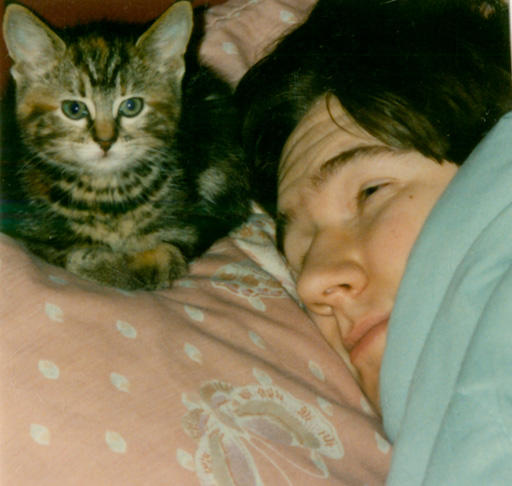
In 1994, when I was 23, Melissa and I adopted a kitten from a stray that someone from work had taken in, and named her Nikki.  She was more neurotic than playful, more stupid than smart, more heavy than svelte.  Her fur was dull, with a dander problem.  Once she was no longer a kitten, she didn’t like being held or scratched for very long.

She turned into a crotchety old woman in about two years.  She now wanted scratching, but only on the sides of her face — and if you weren’t doing it right, she’d bite you as a reminder of the proper technique.  She complained every time you brushed her, making her the only cat I have ever encountered that doesn’t enjoy being brushed.  She no longer purred, even when given a favorite food or scratched in an acceptable manner.

No matter the outcome, time heals all wounds.  It took the both of us about a decade before we had each other figured out.  Some examples from the last six years:

  • At night, I would sit down at the computer, and she’d bug me to scratch the sides of her face (complete with impatient biting).  Sometimes she’d stand on her two hind legs just to reach something to bite.  Then she’d lay back down, either at my feet or under the nearby table.  Clockwork.
  • I could call her name; like a dog, she would come from anywhere in the basement.  (She preferred to live in the basement, even though she had full run of the house.)
  • When guests visited, she was abnormally affectionate and purred loudly.  To mock me, I suppose.
  • When I tried to record video of anything, she made sure to get a word in edgewise to ruin the shot.  You can hear her at the end of the 8088 Corruption google video, for example.
  • When I got up and left the computer room, she pretended not to notice.  Yet whenever I returned, she’d be at the doorway.
  • When we developed a mouse problem one year, she left me mice under my chair until I got the hint that the mounting corpses were not an isolated event.
  • Amazingly, she learned to teleport.  At least, I think she did, because whenever I sat down to watch some TV, she would somehow appear next to me on the couch without me noticing how she got there.

I also found out that if I held her very tightly, as in preventing-her-from-escaping tightly, she would actually enjoy it, settle down, and start purring.  This, after 13-odd years of not purring.  Crazy.  The world’s first autistic cat.

A few months ago, we noticed that the common pet water bottle in the kitchen was getting emptied at nearly double the rate it had the previous year.  We discovered we had a raccoon problem (let that be a warning to those of you with pet doors), and we took care of it… but the water usage continued to be high.  It turned out to be Nikki, who was escaping the comfort of the basement to get additional water when hers ran out.  We then found her pooping outside of her litter box.  Then the pooping slowed to one movement a week, while the wayward urination grew to such volume that it saturated her litter box every day.  I didn’t want to admit it, but recognized this as chronic renal failure.  We’d been through CRF with a previous pet.  CRF is terminal.

Two days ago, I made the heart-wrenching decision to put Nikki to sleep.  My decision was made to spare her the later stages of CRF, which include severe pain, wasting, uncontrollable vomiting, and convulsions, all of which can last for weeks before death.  I wanted her to leave this world in comfort, with dignity.  I spent last night with her doing whatever she wanted to do, which was mostly laying on me and watching TV.  (I am fortunate she enjoyed watching UFC and Adult Swim as much as I do, so we didn’t have to fight over the remote.)  I dragged a string around the floor, which she chased, even at her age.  I let her eat some of my cereal.  She took a nap while I read a book.

We said goodbye this morning.  I had to pull over driving back.

She was 15 years old.  She witnessed my marriage to Melissa, then the birth of my two children.  She was that unique type of cat who acts more like a dog than a cat, as she was somehow always in the same room you were in.  In fact, I think that’s why she preferred to stay in the basement:  Not to avoid the dog, but to be around someone with consistent patterns (me).

Most owners would prefer that their cats not bite their fingers.  I am already missing it.

Nikki in 1994

Nikki in 1994

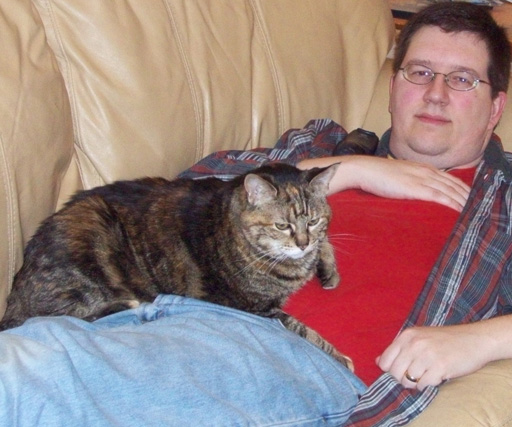
Nikki in 2009

Nikki in 2009

Posted in Family | 51 Comments »

The Incredibly Shrinking Trixter

Posted by Trixter on March 26, 2009

I am finally reducing my volume and mass, and all it took was a combination of several events that converged into a resonance cascade of motivation.  Let’s examine three big events in three small paragraphs.

One of my demoscene friends, RaD Man, went from being 30+ pounds overweight to running 10K races every weekend in about one year.  I know he got a new job in that time, and also got a Wii Fit, but his personal motivation isn’t really important:  He did it, and he looks fantastic.  He also recently got hit by a drunk driver while he was running — then got up and ran alongside the still-moving car, pounding on the door, until the lady stopped and police could arrive.  The twisted moral I take from that story:  Don’t get in shape so that you look good for the ladies; get in shape so you can survive getting hit by a fucking car.  (BTW, it’s looking like he didn’t break anything, thank goodness.)  While I don’t plan on getting hit by a car any time soon, it is an eye-opening reminder of why your health is usually the most important thing you should spend time on.

2009 is the year of my 20-year high school reunion.  I still carry emotional/mental/social baggage from high school.  Not all of the baggage is bad; a small portion of it is positive and wonderful.  But I still want to go to the reunion to gain some closure to that period in my life.  While it is unrealistic to think I can look younger than I am, I want to at least look recognizable.

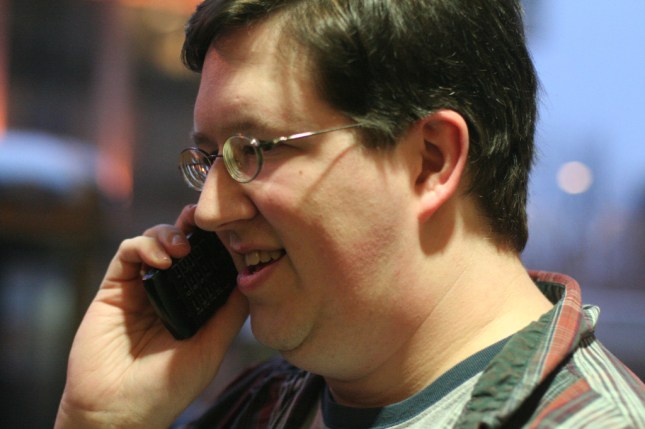
One year ago, my friend Jason Scott took a moment to take a candid picture of me at a very happy moment in my life.  I had just arrived to Block Party 2008, and was very happy and excited to be there; I called Melissa to let her know that I had arrived safely and talk about how great the next few days were going to be.  Jason is a good photographer, and he had his digital SLR with him.  Here’s what he took:

Heavy Jim at Block Party 2008

By all measures, this should be a picture I cherish.  In reality, I am saddened and depressed every time I look at it.  I didn’t recognize this person, and even today I’m not sure I do.  I know that sounds melodramatic and stupid; I can see that even as I write the words!  But you have to understand that, until I saw that picture, my internal body image was that of me right out of college, fit and decent-looking.  It was a bit of a shock to realize that, yes, I was 60 pounds overweight, and my neck fat protruded farther than my chin.

The day I saw that picture (about a month after the event), I stopped gaining weight.  In December, I joined Weight Watchers.  Today, 3.5 months later, I have lost 20 pounds and continue to lose about one pound a week.  Assuming this rate continues, I will be under 190 pounds by the time my high school reunion rolls around, and I can live with that.

Posted in Lifehacks, Weight Loss | 6 Comments »

Learning to let go

Posted by Trixter on March 16, 2009

There’s a happy ending in here, so don’t cry for me Argentina.  Also, it rambles a bit.  These conditions should come as no surprise to those who know me.

For many collectors, librarians, and historians in the field of computer preservation, there is a line between “productive” and “OCD hoarding complex”.  I wouldn’t call it a fine line — it’s pretty broad — but a couple of measured steps in one direction and you can easily travel from museumland to crazyville.  My collection, for example, takes up about seven bookshelves (software) and about 700 cubic feet of space (computers/hardware in the basement and crawlspace).  I usually have three or four projects around me at a time, and so my work area is usually always quite cluttered.  For my current state of project completion, I consider myself right on the line:  If I acquire more stuff, it will progress from “cute little stockpile” to “life-threatening”.  If I let go of some stuff, it will migrate down to the happy state of “collection”.  But as a collector, it is against the fiber of my being to let go of… well, anything.

There are several things that tug at the heartstrings of a computer historian.  The most common is the occasional report of a large collection that was junked because the owner (or widow) didn’t know what they had.  Those are frequent enough (and geographically distant enough) that it’s easy to develop a callus.  Less common are when collections are offered directly to you, but you don’t have the space/money/time/permission/health/etc. to accept them.  Even less common are reports of collections that have been lost not due to negligence, but rather some sort of unexpected disaster (ie. fire, flood, etc.).  All of these royally suck ass, for lack of a more eloquent colloquial euphemism.  But the absolute worst is when you’ve done everything right — found assets, stored them properly, tagged and cataloged them — and circumstances dictate that it is you who needs to give them up before they have been fully processed.  And that time finally arrived for me.

I decided to let go of arguably the golden nugget of my collection:  My cache of Central Point Option Boards.  The personal aftermath of this decision surprised the hell out of me, as I actually feel… better about the entire experience.  (I lack the psychological knowledge to self-analyze why that is; suggestions welcome.) Why did I let them go?  So I could attend a demoparty.

Let’s talk about demoparties.

One of the things I look forward to most in life (other than family events, of course) is attending demoparties.  Europe is maggoty with demoparties (if you look hard enough, you will find at least one every weekend), but here in North America they are few and far-between.  The most amount of major NA demoparties we have had in a single year is two, and that was last year!  (And that won’t be repeated in 2009 because NVision will not occur this year.)  And because NA is so big, it can be a significant financial investment to get to one if you don’t live nearby.  Luckily, Jason Scott — probably at significant personal detriment — has committed to putting on no less than five annual large demoparties, which he both organizes and hosts.  This year is the third one, and although it isn’t as big as some Euro parties, it definitely has the correct vibe, which is a major accomplishment for being so far away from the demoscene nexus.  It’s got a room away from the convention that hosts it all decked out for coding, watching demos, meeting with sceners, listening to demo tunes, etc.  There are compos (including a true wild compo) in front of an audience of at least 200 people.  There are many scene in-jokes floating around.  There is booze of exotic varieties, ranging from home brews to salmiakkikossu (salmari) and a lot inbetween.  About the only thing missing is a bonfire — which is admittedly very difficult, since most NA demoparties are inside convention centers, hotels, or schools.

I mention the demoscene stuff because it is one of my first loves — and the Option Board is another.  In fact, my involvement with the Option Board (is this starting to sound dirty?) goes as far back as 1987.  I became so intimate with it (yeah, this is starting to sound dirty; my apologies) that I began to develop a sense for what settings to give the software based on the publisher of the game I was trying to copy before I even looked at the disk.  Even today, I use Option Boards in my hobby work, sometimes even transferring difficult disk images to overseas colleages who are more adept at cracking than I am, so that they can be dismantled and released into the wild.

So.  I love demoparties and I love my collection of Option Boards.  I lacked the money to go to Block Party this year.  I could sell the Option Boards, to get the money, but I hadn’t properly archived them yet (meaning, put up a web page about them, describe them and their usage, trivia, etc.), which is something I usually spend months doing — because I am anal about stuff like that.  I was stuck.

So how did I resolve these two diametrically-opposed objectives?  I cheated. I decided to perform a best effort at a quick documentation and archival process, and then sell them.  For a single weekend, every spare moment of time was spent scanning manuals and other materials, copying software, taking photos, and writing up a small history of the boards and how to use them.  All of this was organized into the Option Board Archive, which is now available for your leeching pleasure.  In an age where the DMCA is used for repeated abuse, the Option Board is a historical curiousity: A product marketed specifically to break the law (if you used it inappropriately), so I am glad to have had the chance to make my contribution to the world of Option Board history.  And as for the boards themselves, they are on their way to their new owners.  Two of them are going to a computer history museum in Germany; another is going to the KEEP project in France; the other three are going to private collectors with an active interest in using them to further their vintage computing hobby.

I can’t see a downside to this:

  • I get to go to Block Party, on my own terms (I’m paying my own way — my attendance is not conditional on any obligations.  That means a lot to me.)
  • I got the damn things archived and documented
  • I get to see other vintage computing hobbyists enjoying the boards
  • My family gets to see some more clutter go out the door

Life is good.

So does this mean I’m going to start liquidating everything I have, to achieve a zen-like state of higher conciousness?  Um, hell no — at least, not before I’ve had a chance to archive it all properly.  2010 will be the year of the soundcard museum, mark my words.  Now where did I put those Interwave cards…

PS:  I saved two boards for myself.  I’m not that crazy.

Posted in Demoscene, Software Piracy, Vintage Computing | 6 Comments »

Editing HD On a Budget: Cost of Entry

Posted by Trixter on March 3, 2009

Blu-Ray Disc (BD) is expensive to produce.  As previously ranted by a good friend of mine, the minimum cost to produce a BD is a whopping $4600 — $3000 for some licensing cost that goes who-knows-where, and $1600 for a sanity-defying mandatory AACS encryption procedure.  And this is before you press a single disc.  (If you’re wondering why content producers were rooting for HD-DVD to win the format war, it’s partially because of licensing fees like this, plus lower manufacturing costs.  The cost of entry was much lower compared to BD.)  Needless to say, we have to be very careful how we produce MindCandy 3, because these licensing costs automatically take a giant chunk out of the resources we have available.

And what are those resources?  I’ll describe our budget thusly:  Dan and myself put up the initial capital in 2000, with the hope that we would at least make it back, as well as some extra that would fund a second volume.  That second volume would sell, which would make just enough for the third volume, etc.  The goal from the beginning was to try to have the project generate the money it needed to keep going for as many volumes as possible.  When we found ourselves with a little extra, we donated it to scene.org, or sponsored some demoparties.  When we found ourselves a little short, we did everything we could to keep costs down.  This is no different than the reasons why people organize demoparties, really;  for example, Scamp wants Breakpoint to be successful enough so that, instead of losing 10,000 euros, he can break even and put on another party next year.  The goal is equilibrium.  For the first two volumes, we achieved it.   Now, with BD having such a giant up-front cost, that equilibrium is in jeopardy and forces us to look at alternative ways of producing volume 3 so that we don’t run out of money before it’s ready!

There are many places where money goes in the production of any end-user product, but they tend to fall into the following buckets:

  1. Development
  2. Pre-Production
  3. Production
  4. Post-Production
  5. Distribution

Luckily for us, some of these buckets have no cost other than our personal time.  Development and Pre-Production are all organizing and research, which we do for free because we like doing it.  Thanks to the demoscene community, Production also has no cost as long as we get permission from the authors.  Post-Production involves a hardware and software cost (storing, editing, mastering, and authoring the footage onto media), and Distribution is a setup fee, a per-item manufacturing cost, and shipping costs.  (We also budget for the free copies we set aside to everyone who authorized their demo to be included, provided commentary, donated time or materials, or helped us out in some other way.)

The Distribution cost, thanks to the ass-tastic licensing I mentioned previously, is relatively fixed.  The Post-Production costs, however, are not, and this is where demoscene sensibility comes into play:  How can we make the best of what we’ve got?  What can we pull off, given the limited resources available to us?  It’s time to make a demo — using budgets!  A budgetro, if you will.

In a later post, I’ll start diving into the gritty details of how we’re able to edit HD footage at less than 1/100th the cost of how production companies normally edit HD footage.  Stay tuned.

Posted in Digital Video, MindCandy | 12 Comments »