Oldskooler Ramblings

the unlikely child born of the home computer wars

Archive for the ‘Gaming’ Category

Government workers are so very helpful

Posted by Trixter on October 25, 2006

In all my days of computing, the software that has impressed me the most has been software that pushes a machine seemingly beyond its limits, making it do things that it was never meant to do. One such piece of software was ICON: The Quest For The Ring. It tweaked CGA to within an inch of its life, displaying 16-color graphics on a video card only meant for four ugly colors in graphics mode.

I’m a software collector. I collect vintage retail packages of software as a hobby. (I’m comfortable enough with my nerditude to admit this, so go ahead and mock me — I don’t mind.) So imagine the nerdly dance of joy I did when I found that ICON was up for auction, bid on it, and won! The package I’d been searching for for over two decades, the game that had inspired me to learn assembler and graphics tweaking, the game that shaped my hobbyist world, would finally be mine!

That’s where the governmental workers come into the story. It seems that they were in need of a football to relieve the overwhelming tension and stress of delivering packages, so what I actually received was this:

If you’re not familiar with the hobby of software collecting, I can sum it up in five words: The Value Is The Box. 90% of a software collectable’s value is in how good a condition the box is, then the printed materials inside it, then the diskette labels, then finally the actual software code itself. (Why? Because most software has been pirated already… and most people throw away the box and lose the manuals.)

My twenty-year dream quite literally crushed, I decided to visit my local US Postal Services office to file the claim for the $50 I had paid for it. And this is where we again meet our lovable and cute governmental workers, for here is what I learned today about insuring packages:

  1. You have to provide proof of the item’s value. So if the USPS determines that your item is worth less than what you insured it for, and you cannot provide any “documented proof” (the validity of which is at the government worker’s discretion, of course) that it is worth more, you get what they are willing to give you, not what it is actually worth. This is how they justify giving you less money than the value you wrote down on the form when requesting insurance, they always offer a very cheap car insurance but then you end up with such bad service or no service at all.
  2. You cannot insure something for more than what you paid for it. See #1 for rationale. So if you completely luck out and find an Akalabeth with a Buy It Now of $4, the most you can insure it for is $4 even though its value is anywhere from 10 to 150 times that value.
  3. If your item is only slightly damaged, and you want to keep it, you can’t. You must completely give over every single thing you are filing a claim for, never to be seen again. This means that there is no protection against *partial* damage — if it’s partially damaged, bend over, since you can’t get partial money for it.

See, all this time I was under the silly impression that, if you insured something for a certain dollar value, that was the value they were going to give you when you showed them it was damaged. Or that maybe, just maybe, you were insuring it against partial damage — like depreciation or something. How wrong I was: Insurance is only protection against complete and total destruction of property and/or complete and total loss of delivery. If it *arrives*, and is only *somewhat* damaged, you’re shit out of luck! How glad I am to be educated! (although I could have done without the “bending over the table” portion of my education)

So what did I do? I made the obvious determination that something I had been searching two decades to locate — in *any* condition — was worth more than the $15 or so they were going to give me for it. So I tore up the claim form, took back the item, and left. Since then, I have been researching cardbox box reconstruction techniques, for I am not only a nerd, but a stubborn nerd.

About the only satisfaction I got from today’s visit was the audible popping noise the government worker’s synapses made snapping apart into individual neurons as I tried to explain that, yes Daisy Mae, the value really was the BOX itself and not the contents inside it. The complete and total lack of understanding confused her to such a degree that she was unable to blink her eyes in unison for at least 10 minutes after I stopped talking. I could have done without the drool, though.
Posted in Gaming, Programming, Software Piracy, Vintage Computing | 5 Comments »

Patience

Posted by Trixter on May 24, 2006

I never said I was a patient man. As a young teen, I would cheat on book reports by reading the Cliff notes or watching the movie. I would rush to the 7-eleven directly after school on Fridays to grab the latest comic books (this is before all the comic shops standardized on Wednesdays, obviously). I loaded COMMAND.COM into a RAMDISK so I wouldn’t have to keep replacing the floppy boot disk after I ran large programs. That sort of thing. Well, I squeaked through high school. I eventually gave up reading and collecting comics. I got a hard drive in 1990 and stopped booting off of floppies. A lot of my issues corrected themselves as I got older.

Except Hack.

In January of 1985, the very first game I played on the family 8088 was Hack. It was given to me by a friend of my brother’s, and it was yet another life-defining moment; the good kind, where it shapes you positively while you’re not paying attention. Being the first PC game I had access to (my prior pirating experience was Apple II), I was determined to give it a shot. Ironically, getting Hack up and running involved some hacking in and of itself: You had to alter config.sys to add ansi.sys; you had to alter hack.cnf to define how many drives you had, or a hard disk; you had to learn several bizarre movement keys like K for up, J for down, and other stuff that didn’t make any sense. It almost wasn’t worth the trouble for a young PC user.

Once fired up, Hack treated me to a complex dungeon where almost anything could happen: Shoot a bolt of fire, have it bounce off a wall, and ricochet back to hit you and catch your scrolls on fire; or kill an animal that turns people to stone, put on some gloves, and then use the dead carcass to turn enemy monsters into stone; etc. It was complex, it was deep, and it was wonderful.

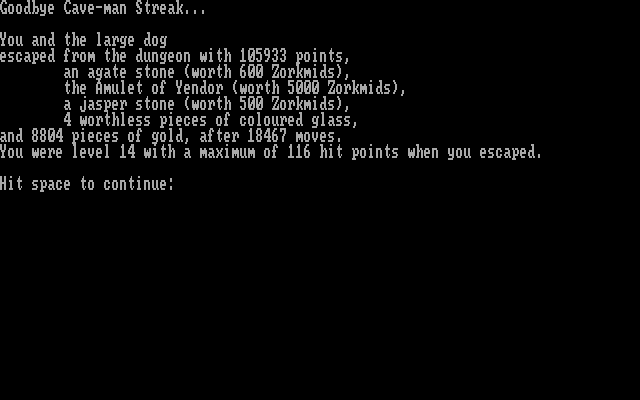
It was also harder than a motherfucker. Hack, and its descendant Nethack, are some of the less forgiving members of the Roguelike family. It was relatively easy to go from king of the world to king of the dead in as little as a three moves. Every new machine I bought or built would get Hack installed as a nice little “initiation”, and every time I wouldn’t finish. I’d fire it up a few months later, 5 or 10 times a year, still wouldn’t finish. I’d cheat terribly, even finally finding the Amulet of Yendor, and the game would catch me cheating and write “You escaped with a CHEAP PLASTIC IMITATION of the Amulet” to the high score file. The screams of frustration were audible for several city blocks.

I got better. I found all sorts of things totally by accident. Eat a floating eye and you get sick, but if something later blinds you (like a flash of yellow light, or a potion of blindness), you can suddenly see ALL of the monsters in the level. Get drunk and read a teleportation scroll, and instead of teleporting somewhere else in the level, you teleport to a different level entirely. The more I played, the more I discovered. (I also discovered later in life that hack had prepared me for Unix administration, since the movement and option setting keys are identical to the “VI” file editor.) Yet I still didn’t finish.

Two weeks ago, I decided to play Hack on my 8088. I had forgotten how slow it played; the more monsters that were roaming the level you were on, the slower it took to respond. And it was then that I realized I could use that artifact of processing speed to my advantage. Most of the time that I had died, it was through some incredibly stupid event, like a dragon turning the corner and frying me with a bolt of fire, or not knowing that an umber hulk was in the same darkened room as I was, making me confused. When a level went from fast response to slow, it meant that a large amount of monsters had suddenly materialized. I would immediately check myself and carefully consider each decision. With this newfound realization, I played with hyperfocusing intensity over the course of several days.

Today, twenty-one years after I first got Hack working on my 8088, we come full circle, back to the 8088, to what I think are the two most lovely text screens I have ever seen on any CGA monitor:

hack1

hack2

I never said I was a patient man… but I guess I am :-)

Update, 1/7/2012:  I just today learned that Donnie Russell’s excellent Windows port of Hack has now been ported to Flash and can run in any browser that supports it.  It supports saving as well as some cute sound effects.

Posted in Gaming, Vintage Computing | 5 Comments »

World Champion

Posted by Trixter on January 21, 2006

I was talking to a demoscene aquaintance via IM tonight, and asked him what his avatar picture was. He said it was from Hat Trick Hero / Football Champ (Taito, 1990)… and also casually dropped the info that he was the world champion of that game, by a large margin. Which reminded me of my “World Champion” theory: I believe that everyone, everywhere, is World Champion of something, although they may never find out what in their lifetime. There are people who work very hard at something and achieve it, like Lance Armstrong, or are born with good genes and figure out the best way to exploit them through incredible practice and work, like Arnold Schwartzegger.

But what about the unknowns? Like the housewife who accompanies her husband to a shooting range and, on a complete whim, squeezes off a few shots and to everyone’s amazment she’s a crack shot with perfect aim… or like Jimi Hendrix, who did crazy unconventional stuff that the world may have never known if he hadn’t picked up a guitar. That’s the kind of stuff that fascinates me, and my friend was lucky enough to figure out what he was World Champion of. Bastard :-)

Posted in Gaming, Uncategorized | Leave a Comment »

Programmers: Deeper understanding of video games?

Posted by Trixter on January 11, 2006

Being a programmer for two decades has given me a special insight into video games; because I know how the majority of them are programmed, hardly any of them feel foreign to me. I may not be a master at any one particular game, but I can definitely pick them up quickly.

This has led to some chuckles along the way. Two games popular around the house lately have been Need For Speed Underground 2 and Ratchet: Deadlocked. In NFSU2, you can use a simulated GPS to continuously point an arrow to your destination so you can find it easier. When you first select the destination, it pauses for a few seconds with the text “Searching Connection: Unable to contact Satellite”. Sounds like a cute simulation, yes? Because I’m a programmer, I know what’s actually happening: The pathfinding algorithm is slow and taking a few seconds to plot the quickest path to the destination. The programmers of NFSU2 masked that pause with the “Searching Connection” message so the user wouldn’t see it as a flaw.

As for Ratchet: Deadlocked, there is a 2-player cooperative mode where you can play through the game with a friend. If the two of you get too far away from each other while playing, the game threatens to blow the both of you up if you don’t get closer to each other again. While this looks intentional, I have a very strong suspicion that it is there to mask a limitation of the game engine — such as, if both players are too far away from each other, that’s too much geometry for the engine to cache and fling around.

I’d be curious if anyone else notices things like this…

Posted in Gaming, Programming | 5 Comments »

A Sam and Max of my very own

Posted by Trixter on January 7, 2006

Okay, once and for all: No, I did not intentionally name my children Sam and Max after Steve Purcell’s excellent comic series (or the Lucasarts game). But I am glad it worked out that way :-)

In a few years, they’ll be old enough to play it — I can hardly wait!

Posted in Family, Gaming | 2 Comments »