Oldskooler Ramblings

the unlikely child born of the home computer wars

If you’re gonna screw up, do it while you’re young

Posted by Trixter on December 28, 2010

I’ve been quiet for a while due to dealing with changes in my professional life.  I normally don’t talk about work in my personal blog because I don’t want to misrepresent my current or former employers — when you have a family to support, you don’t shit where you eat.  But I owe a lot of people an explanation as to where I’ve been for roughly 18 months, so I’ll summarize:  I took a job in the trading industry, and while it had some awesome positives, it was the wrong environment for me and I was very unhappy there. The last four months in particular had me so depressed that I broke through the “eat to fill the pain” stage to the “stopped eating entirely” stage and started losing weight and sleep.  I started to doubt myself and my abilities, worrying that I wouldn’t be able to earn a living for much longer. After an ultimatum at work, I put myself on the market and 5 weeks later I accepted a positon in a large commercial industry. And I’m a lot happier — not because of leaving the trading job, but because I was able to recognize a bad fit, was willing to crawl out of my emotional hole, and rebooted my situation.  (The Winston Groom quote seemed appropriate, hence the title of this post.)

I also got a spiffy new Samsung Galaxy S variant (Epic 4G) which has data access no matter where I am (2g/3g/4g/wifi) and has a slide-out keyboard and other bells and whistles, so I have no excuse not to update the blog once in a while, even from a moving commuter train.  Which, guess what, I’m doing right now!

Posted in Family, Lifehacks | 7 Comments »

Vintage Computer Festival Midwest 5.0 Pix

Posted by Trixter on September 19, 2010

I’ve had very little time to play with old machinery this year, but I did manage to visit the VCF Midwest 5.0 this year.  It was hard to avoid, being as it was held about 25 minutes from my house.

Seeing as this was combined with the yearly local Commodore 64 fest, it was a bit of a double-fest. Jim Brain was there, and I also had a nice conversation with Nate Lawson who educated me on the finer points of how BD+ does and does not work. MC3 will intentionally use as little protection as possible, but the 16-yr-old cracker in me still likes hearing about the details.

I couldn’t arrive until 9pm, but most of the exhibits were still up.  I took pictures with my 9-yr-old 4MP “prosumer” camera, and was mildly happy with how they turned out.  Enjoy:

Vintage Computer Festival Midwest 5.0

Posted in Vintage Computing | 6 Comments »

My So-Called Series

Posted by Trixter on August 12, 2010

I’d like to take a short break in my audio-cassettes-included-with-classic-computer-games series to ask a question:  What series have you tried to collect, and why?

Most collectors of classic game software tend to focus on an entire company (Sierra, Infocom, Adventure International, etc.) while others tend to hone in on a particular series (Wizardry, Ultima, etc.)  I am guilty of both, but my collection is biased towards series that may not seem to be worth collecting, have any relationship to each other, or have any rational pattern (even to fellow collectors!).  What I collect reflects why I like old PCs as a hobby:  Not because “old komputers R k00l” but because “what people did to get past old computers’ limits is k00l”.  If a game was really well-programmed, or had great graphics, or managed to produce audible sound out of the beeper, it gained my admiration.  Sure, story and gameplay mechanics are a contributing factor, but they’re not the main focus of my collection.

Another odd thing about what I collect:  It’s 99% PC.  I have some Apple II, Mac, and C64 titles, but those have been donations I’ve promised to take good care of, and I have.  My heart lies in the original PC, mostly because it was the hardest platform to get a decent game experience on, making successes all the more impressive.  This is atypical; most of my fellow collectors don’t discriminate platforms like I do.

Here’s an incomplete list of some “series” I’ve collected and why I consider them a series:

All the PC versions of Cinemaware adventure titles: Defender of the Crown (including the euro bootable EGA/Tandy/3-voice version), King of Chicago, S.D.I., Sinbad, The Three Stooges, It Came From The Desert, Rocket Ranger. Cinemaware games were a mixed bag:  Awesome graphics, music, and sound — on Amiga.  Other platforms usually got worse graphics and sound, but better gameplay because they would tweak some games between platforms.  Play the original Defender of the Crown for Amiga and you’ll find it is nearly impossible to win.  Play it on C64 or PC, and you’ll find it’s a much more balanced game.  Anyway, the graphics rocked CGA at the time.

EA Chuck Yeager flightsim series:  Chuck Yeager’s Flight Simulator, Chuck Yeager’s Flight Trainer 2.0, Chuck Yeager’s Air Combat. The first was a very fast simulator for an old PC with CGA; you could even flyby the “EOA” logo in the desert.  Then Microsoft sued over the “flight simulator” name and they quickly rebranded it as Flight Trainer.  Then came Flight Trainer 2.0 with more of a focus on training, and an audio cassette with many notes from Chuck himself.  Finally Air Combat, with a completely new engine by Brent Iverson which traded 20% less speed for 100% better graphics, models, video modes, clouds, cameras…

Deus Ex series: Deus Ex, Deus ex 2: Invisible War, Project: Snowblind. Snowblind?  Yes, Project: Snowblind was originally developed by Crystal Dynamics as a spin-off of Invisible War, but when DE2:IW sold poorly, the story and assets were changed somewhat to distance the game from a then-failing property.  Playing the game, however, reveals much of the familiar Deus Ex biomod mechanics, and the story — while taking a backseat to action — smells heavily of conspiracies, like all Deus Ex games.

Sierra Game Arts collection:  Thexder, Silpheed, Firehawk, Sorcerian, Zeliard.  All of these games were ports from the PC-88, and all of them look best in their native 640×200 16-color mode which you can see on a Tandy SL/RL/TL series computer or on an EGA card with more than 64K of video RAM.  For everything but Silpheed, the full-screen graphics updated very quickly by dividing the entire screen up into 16×8 tiles (8×8 if a 320×200 mode) and only repainting the tiles that change.  Since movement was quantized to tile locations, very little updated per frame even though it didn’t look like it.  These were essentially 40×25 textmode games but using graphical tiles — brilliant!  (Oh yeah, they also support Tandy 3-voice sound and all but Thexder supported a ton of extra sound devices for the time, but it’s the graphics mode and engine that I love.)

DSI road engine games: Test Drive, Test Drive II, Outrun, Grand Prix Circuit, The Cycles.  This is extremely obscure and deserves an explanation.  When Distinctive Software Inc. was an independent Canadian developer, they came up with a relatively simple-yet-effective road repainting engine that got used in several games published by Accolade:  Test Drive, Test Drive II, Grand Prix Circuit, and The Cycles.  During this time, they also took on a job for Sega porting Outrun to the PC.  They used the same engine, which one could argue they didn’t own because they developed it while under contract from Accolade.  They must have known something was up because they didn’t use their DSI name and logo, but instead used Unlimited Software Inc. Accolade felt they violated a working agreement, and filed a lawsuit.  (Ironically, the Outrun version of the engine is the smoothest, running much better on faster machines.  It’s playable even on gigahertz machines.)

Would you be fooled by this?

DSI:USI:

Access adventure Series:  Mean Streets, Martian Memorandum, Countdown, Amazon: Guardians of Eden, Under a Killing Moon, The Pandora Directive, Overseer. Access knew that the best technology could sell games, even if the story was a bit lacking.  Their engines had (crude) motion video, digitized audio, and 256-color graphics as early as 1989.  Later games like Under a Killing Moon and Pandora Directive also had a great engine with pre-rendered lights and a fully-textured world to explore.  While I loved all of them, my heart belongs to the Mean Streets engine because it used 256-color VGA graphics as the base data but would FS dither to all common lower graphics modes as well.

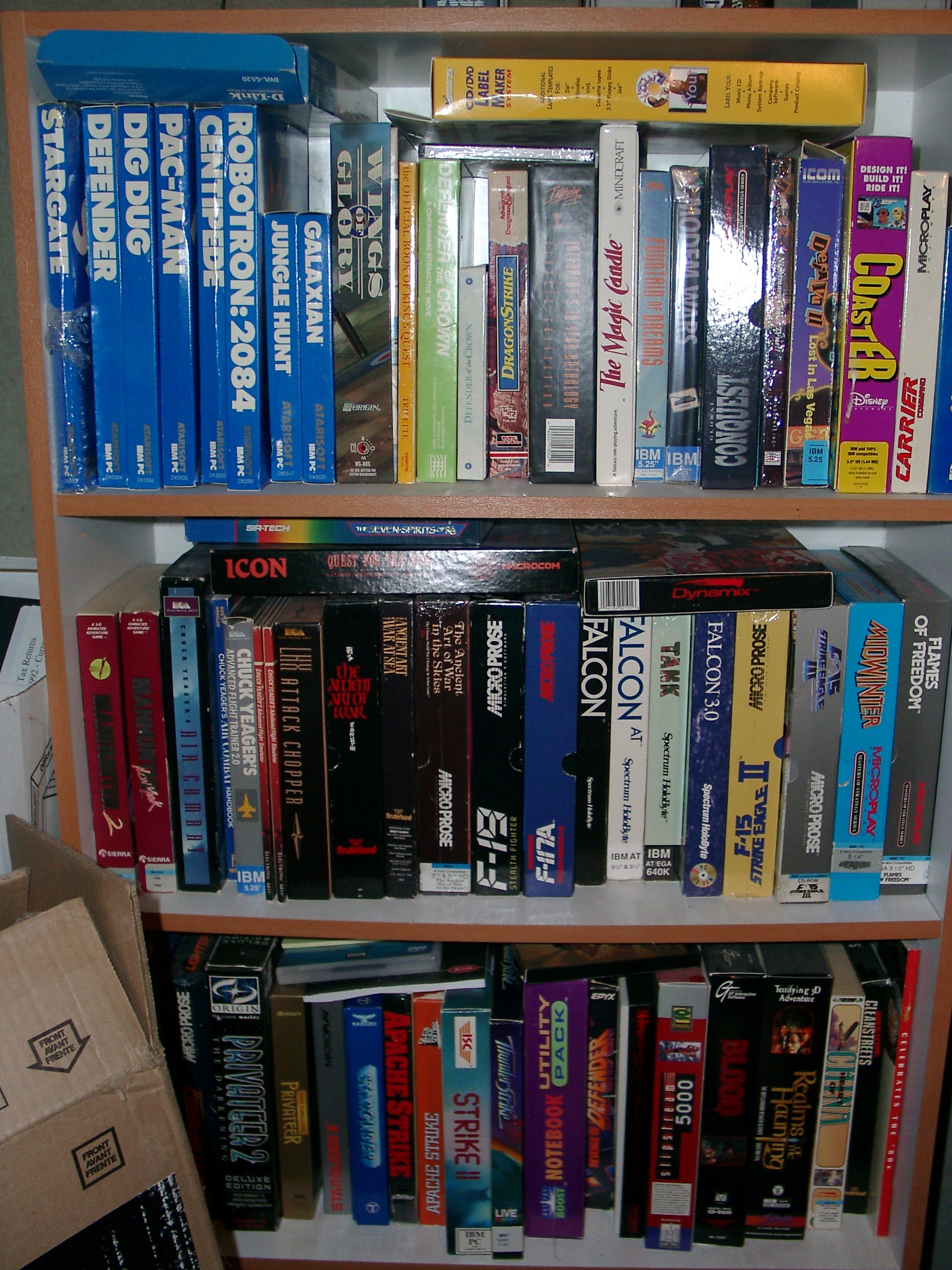
Here’s part of one shelf of my collection; I have five more shelves:

bookshelf filled with computer games

It’s a small collection compared to some of the superstars of my hobby, and I’ve had to pare it down over the years due to financial hardship, but I’m happy with what I have. It’s special to me, and that’s what counts.

Posted in Gaming, Vintage Computing | 17 Comments »

Stone Age Multimedia: Corruption

Posted by Trixter on August 7, 2010

(What follows is a continuation of an article about audio cassettes included with computer games; if you would like to start at the beginning, start with Homeword.)

Corruption

Corruption was one of the legendary Magnetic Scrolls series: text adventures from the UK that are regarded by many to be on equal footing (if not better) than the venerable Infocom series of interactive fiction.

Playing the included audio tape before it’s required by the game isn’t recommended, but doing so sets up the basic premise of the story. The first track on the first side of the tape is a conversation with your boss that was used to frame you. In it, you hear your boss calling you into his office and confronting you about insider trading. (boss: “Using heavy inside knowledge — it’s a criminal offense.” you: “I agree.”) The conversation generally makes you out to be the bad guy (at one point, you bluntly answer accusations with “I’ll be frank: I admit it.”) For atmosphere, the tape has “Derek Rogers, March 25” scrawled on it in a kind of handwriting.

Sounds pretty damning, doesn’t it? There’s only one problem: You never had this conversation with your boss! You’ve been framed! You have to unravel your life and figure out the corporation’s secrets to win the game and get your life back.

C. E. Forman, an avid interactive fiction gamer, had this to add:

During the course of the game, you the player-character actually find this tape in one of your business partners’ offices, and can play it in the cassette deck of a car you break into. (Magnetic Scrolls also offerred a written transcript you could send for, in the event that the tape got damaged, since it’s a rather vital part of the plot.)

After the conversation, the theme music written by John Molloy starts. The title theme is extremely appropriate for the source material; the musical style evokes images of a mystery that needs to be solved, with sympathy for the hero. The other side of the tape, which is unlabeled, hides the original conversation you had with your boss from which the “framed” version was created. It’s a bit long, but is engaging to listen to as it demonstrates where your tormentor got all his sound bites from to make the version that framed you.

All in all, the tape adds a nicely textured clue that helps flesh out your purpose (and what you’re up against) in the game.

Highlight: The passage “Stupid sod spilled all the beans!” in the “framed” version of the conversation.

High Points: Good voice acting; realization that the “framed” conversation is very cleverly edited together once you hear the original conversation.

Low Points: Annoying reverb effect applied to both actor’s voices makes it hard for some to understand what they’re saying

Audio: For this installment, I’ve linked to the various available mp3s in the above article text.

Posted in Gaming, Vintage Computing | Leave a Comment »

Stone Age Multimedia: The President Is Missing

Posted by Trixter on July 31, 2010

(What follows is a continuation of an article about audio cassettes included with computer games; if you would like to start at the beginning, start with Homeword.)

The President Is Missing

The unthinkable has happened: During a secret conference of national leaders in Switzerland, terrorists break in and capture several world leaders, including the President of the United States! It’s up to you to find out where he is by examining all of the evidence, including multiple audio cues and photographs. Along the way, you’ll uncover a diabolical conspiracy (of course) that may involve even those closest to the President himself.

The audio cues you need to play the game are numerous and vital to solving the game, so they were provided on the included audio tape. In addition to setting the mood for the game through some introductory audio clips, you have a multitude of “file tape” recordings that can help you locate the President and solve the case. Included are interviews with government officials, taped radio communications, recordings from tapped telephones, the terrorists’ spoken demands, and even some (very squelchy) morse code signals.

All in all, it makes for a good mystery. Cosmi titles were never high on quality, but The President Is Missing makes a great attempt at publishing a good game.

High Points: Wide variety of clues; slow realization that it’s not quite as important as what is being said as to how it is being said.

Low Points: Voice acting ranges from acceptable to poor; recording quality ranges from good to poor; too many audio clues lessens the impact of all of them (in other words, a few great clips would’ve been much better than tons of mediocre clips)

Highlight: Hearing an unlucky informant getting blown to smithereens over the phone. :-)

Audio: The President Is Missing Side 1 and Side 2 are available.

Posted in Gaming, Vintage Computing | Leave a Comment »

Stone Age Multimedia: Sub Mission

Posted by Trixter on July 23, 2010

(What follows is a continuation of an article about audio cassettes included with computer games; if you would like to start at the beginning, start with Homeword.)

Sub Mission

Continuing our exploration into the mind of Tom Snyder, we pull 180 degrees and take a look at Sub Mission, a diabolical game of hide and seek with a warlord. It takes place underwater using submarines and mines; a bit of action, a bit of simulation, and a bit of strategy round out this game with very unique aspects. Sound unique enough for you? If not, consider this: If you play the game “for real” (ie. not with “robots”), you run the risk of permanently killing one of the characters in the game, who has clues vital to escaping. It deletes the character data off of the disk!

Gameplay suffers from seemingly poor planning. One gets the feeling that Tom thought of a couple of neat elements — submarine play, hide-and-seek tactics, permanently killing characters, etc. — and tried to mesh it all into a game. The end result has some holes in the story, and some gameplay elements feel arbitrary and forced. These elements are probably what prompted for the inclusion of a cassette in the game: The first side of the tape has an 8-minute introduction that sets up the premise, and the entire second side of the tape — 22 minutes — is an extremely thorough tutorial.

Highlight: (Cheezy) Computer telling the player that “To save them, you have to play the game — and play to win!

High Points: Tutorial fully explains all aspects of the game such that reading the manual is probably not necessary; first 46 seconds of the tutorial clearly explains gameplay purpose better than the entire introductory story on the first side of the tape.

Low Points: Weak title theme; “computer voice” in introduction is sometimes hard to understand; (seemingly) randomly-generated music constantly playing in the background; tutorial narrator is dry and reads as if he’s high on weed; repeated careful pronounciation of the words “sonar scope” is irritating to some; tutorial is very long; tutorial was recorded in one take, probably improvised, resulting in some long pauses, stumbling over words, and computer noises in the background; your character himself keeps pointing out glaring holes in the plot and gameplay, such as “Wait a minute — I don’t need those two kids to help me beat the warlord. Why should I risk their lives when I can pilot (the sub) through a remote robot?” and “Why play the wargame at all? Why not just put Sigourney or Peter in the sub and go looking for the escape route?”

Audio: Sub Mission Intro, and Sub Mission Tutorial

Trivia: As previously mentioned, Tom Snyder Productions branched away from computer games and into traditional media, like cartoons. If the name wasn’t familiar before now, do the shows “Dr. Katz” (Comedy Central) and “Squigglevision” ring a bell? They’re the brainchild of Tom’s production company. In fact, listen to the beginning title theme in the Sub Mission intro — there is a faint resemblance to the sequeway music played when moving from one scene to another in Dr. Katz.

Posted in Gaming, Vintage Computing | 1 Comment »

Stone Age Multimedia: The American Challenge

Posted by Trixter on July 21, 2010

(What follows is a continuation of an article about audio cassettes included with computer games; if you would like to start at the beginning, start with Homeword.)

The American Challenge: A Sailing Simulation

Tom Snyder was creating games while the personal computer game industry was still young. As a result, unconventional ideas in gaming were much more widely accepted than today, as the market wasn’t saturated. Tom liked to sail these uncharted waters (if you’ll pardon the bad pun) and created some games that, while unconventional, were generally good. The Infocomics series are part of his experiments, and are are well-known to Infocom collectors. But what of his other projects?

Sailing and music were two of Tom’s passions, and he created a product that had both: The American Challenge: A Sailing Simulation. The sailing aspect is obvious; the music aspect is in the form of the title track “Win Back The Cup”, included with a tutorial on a cassette. It’s generally a bad idea to call your new song “soon-to-be-a-classic” as mentioned on the box advertising, but the truth is, it’s not that bad. Game designer Tony Van mused it was “kinda homey, sorta folksy”, and that’s about right. It’s got a mid 1980’s light rock feel to it. As a theme to the game, it’s catchy. It stands on its own as well — Tom can probably claim to have written the only song ever dedicated to the America’s Cup.

As for the tutorial, it’s cute: Someone (I’m assuming it’s Tom) walks you through starting the game in the character of a New England sailboat captain, complete with accent. The tutorial takes you from choosing program options, to explaining where common simulations items are on the screen (compass, etc.), to helping you bring in your sail to catch some wind. It doesn’t cover the entire game, but it helps novices get the boat moving.

Highlight: A tie, between the pseudo-New Englander trying to pronouce the words “television set” in accent correctly, and the song lyrics “You’ve got the cup, so we’ve got nothing to lose”.

High Points: The sailing song “Win Back The Cup”; narrator of the tutorial does a passable job at a New England accent (“…it looks like a fye-een afternoon to head out into the hah-bah for a cruise.”).

Low Points: Narrator slips out of accent occaisionally; entire tutorial was recorded in one take, so there’s a stumble over words once or twice; tutorial mentions being stuck in irons (when your boat heads right into the wind) but doesn’t address how to get out of it other than to escape the simulation if you get stuck.

Audio: The American Challenge: Title Theme, as well as The American Challenge: Tutorial

Posted in Gaming, Vintage Computing | Leave a Comment »

Stone Age Multimedia: Homeword

Posted by Trixter on July 20, 2010

My software collecting hobby was at its peak about 9 years ago, and at that time I became fascinated by the audio cassettes that came with early computer games.  I’m not talking about computer games that were delivered on cassettes, like C64/Vic-20/Atari 8-bit/etc. computer systems, but actual recorded audio on a cassette to be listened to in a stereo’s cassette deck or boom box.  Before CDROMs, before soundcards, the only way to get high-quality audio into a game was to physically place an audio cassette into the package.  As to why companies would want to do this, here’s a breakdown of the kind of audio you could typically find included in this fashion:

  • Title music (20%)
  • Introduction or backstory (30%)
  • Tutorial (35%)
  • Game elements or clues (15%)

Title music was sometimes serious, sometimes silly, and usually done pro bono by either the programmers themselves or friends wanting to break into the business.  Introductions to the game and tutorials were much more common, especially for more complicated games like simulations.  Game elements was arguably the best use of included audio cassettes, as it provided the designers a way to provide more depth to the game.  For example, In The President Is Missing, the audio provides several clues as to where the President might be held, but you have to listen carefully to terrorist radio transmissions and decode some morse code.  Corruption has arguably the coolest use of cassette audio — the cassette in the game package represents the actual audio cassette that you search for and find in the game world, and listening to it provides insight into how you were framed.  For both games, the cassettes are required listening not only to get the most enjoyment out of both games, but also to finish them!  (Corruption even included a coupon to send in if you didn’t have a way to play cassette tapes, although I don’t recall what the coupon was for — probably a transcript of what was on the tape.)

So, 9 years ago:  Back when I was still writing feature articles for MobyGames, one article idea I had was to shed light on this mostly forgotten aspect of computer gaming history.  I was going to do this by writing up a small segment per game on what audio was included and why, and then provide snippets of audio to illustrate what it was like.  But the more I listened to the tapes and wrote, the more I felt that little snippets of audio weren’t going to be good enough — there was some real historical gems in these things, like Chuck Yeager talking about what it was like to be a test pilot, or how early home computer programs needed to hold the hands of new users every step of the way, or how much craft went into a title song (with lyrics!) composed specifically for a game.  Small snippets of audio just weren’t going to cut it.  But I couldn’t just blatantly reference an entire dump of the cassette either, because I was worried about copyright infringement.  So while I wrote up the entire article, I never published it.

Flash-forward to 2010, and I’m not so worried about copyright infringement any more.  In the last nine years, we’ve seen some great advancements in how game companies treat their older IP — they either respect it and turn it into new-old properties (like Sam & Max or Monkey Island episodes), or they have built goodwill amongst their fan base by either giving away entire libraries (such as the entire Vectrex game library) or changing their minds and allowing fanfic productions to be distributed.  Even Apple, notoriously stingy about protecting their marks and IP, cleared the release of some significantly historical code today (the original QuickDraw and MacPaint).

So I’ve decided to publish the article after all, but as regular installments here in my blog.  I’ve re-read the Fair Use clause of US copyright policy (title 17, chapter 1, paragraph 107 is the relevant part) and I believe my use of these works fall squarely into educational non-profit usage, nor harm the present or future profitability of these works as the companies that produced them are long gone (and, sadly, some of the people involved in creating them are gone too).  I view these installments as a historical exercise, but as always, if any corporate lawyer disagrees with me, I’ll be happy to take the articles down.

What follows is the original intro I wrote for the article, as well as our first featured included audio cassette:  Homeword.

(One note before we begin:  If the audio cassettes sound like they have a lot of hiss in them, that’s because they do.  With only a few exceptions, I did not attempt noise reduction.  Most of these tapes were not produced with any sort of Dolby noise reduction, and so there is a lot of wideband hiss in the audio and attempting to filter it out completely mangles parts of the audio signal you want to keep, like hihats, rimshots, and subtle high-end stuff.)


1983: You’re Sierra On-Line, and you’ve written a word processor that anybody can use, thanks to the clever use of graphics to visualize concepts — paper for files, filing cabinets for folders/directories, etc. There’s only one problem: It’s the dawn of the personal computing industry, and true novices don’t know how to operate the computer they just purchased. How can you wow them with the simplicity of your program when your users can’t even boot it?

1988: You’re Rainbird, and you’re set to publish another one of the highly-regarded Magnetic Scrolls interactive fiction games. This time, it’s a tale of double-crosses as you get framed by the corporation you work for, where you have to unravel your life and their tricks to win. It’s a good adventure, but it’s missing something that would help immerse the player deeper into the mystery. If only there was a way to demonstrate how you were framed…

Pardon the pun, but it sounds like some audio would do the trick quite nicely. A read-aloud tutorial that eases new computer owners into word processing would help Sierra’s case, and the evidence that was used to frame the main character would be a great addition to Rainbird’s game. But what can you do? As a publisher, you can’t just jam disks and disks of digitized sound into the package; the cost would eat at your bottom line. And most computers in the 1980s didn’t have built-in sound devices to play digitized sound anyway, let alone hard drives to store it all.

The solution, for a select few companies, was audio cassettes. I’m not talking about data cassettes that early 8-bit computer programs used to come on, but real cassettes that you can pop into your home or car stereo and listen to. They were relatively cheap, easy to mass-produce, and held at least 30 minutes of stereo sound to fill with what you needed. While cassette players will eventually go the way of the dinosaur in the new millenium, they were as essential a component of a stereo system then as CD players are today. (CD players were considered a luxury in the 1980s.)

The use of audio cassettes in early software (not just games) was diverse: Some held instructions or tutorials, others held enhanced title music, and still others were essential portions of the adventure game you were trying to play — audio cues/clues, if you will. We take multimedia for granted today; there are no game titles released without music and speech that expect to make a buck on store shelves. But opening a software package in the 1980s and finding a cassette — well, that was a real treat. In most cases, it was justified and honestly enhanced the end-user’s enjoyment of the product.

In this feature, we’ll take a look at some of the included audio cassettes that came with early software titles (not all of which were games), examine how they made the software experience more enjoyable for the end-user, and — this is the best part — provide full-length low-bitrate versions of the cassettes so that you can hear what they sounded like.

Just before we begin, we’d like to thank a couple of people:

  • Jason Artman contributed a recording of the Sierra Lounge. Jason has contributed to MobyGames before in a big way: he was the first person to write a feature article for MobyGames.
  • C.E. Forman lent me a copy of The President Is Missing (thanks Chris!). You can visit his excellent Ye Olde Infocomme Shoppe if you want to see how a true software collector works his hobby.
  • Tony Van, who went above and beyond the call of duty to contribute four rare audio clips with descriptions to the project.

We’ll start our journey into the world of low-tech audio with Homeword, a word processor. Wait, don’t leave! Yes, it’s a word processor, but it was put out by Sierra On-Line, once one of the most prolific game companies in the first two decades of computer gaming.

Homeword (Sierra, 1983)

Homeword isn’t a game, but it was produced by Sierra On-Line in the early 80’s, so we thought we’d cover it as a historical exercise.

Homeword was marketed as a word processor for the entire family. Using graphical icons like pieces of paper, a printer, and a filing cabinet, Homeword’s goal was to make word processing easy for someone who had never used a word processor. Only one problem: In those days, it was very common for someone to have purchased a computer without any prior computer experience whatsoever. Users would rely on the software not only to help them perform specific tasks, but also to teach them how to operate the computer in the first place. There wasn’t a common operating platform for consumers like there is today; back then, every program had a different interface. (The philosophy back then was to make program interfaces standard across platforms, which is substantially different than today’s model of making all program interfaces standard across the same operating system.)

Sierra helped solved this problem with a helpful tutorial included in the Homeword package that walked you through the word processor’s various functions. It did so from the absolute beginning: “Hold your diskette with your thumb on the label, label side up. Insert your Homeword diskette into the disk drive, close the drive door, and power on your computer.” The resulting cassette is a mostly a tutorial on working Homeword, but also a small primer on the basics of computing, floppy disks and other basic computer concepts.

High points: Calm, friendly narrator; long pauses while the user attempts what was just suggested; cute early-1980s synthesizer music intro.

Low points: Included pauses weren’t consistent — some were very long for short tasks, other were a bit short for longer tasks.

Audio: Homeword (IBM PC)

Bonus: Homeword (Apple II)

Trivia: Sierra wasn’t the only game company to test non-gaming markets; early software companies often shifted product lines around. Tom Snyder Productions, which we’ll cover later, did the same thing (although the successful business they’re in today is educational software and television production, not entertainment titles). Broderbund came out with several applications for the home, including the popular Bank Street Writer. Even Infocom attempted to go into the business market, but with disastrous results — the effort involved in getting the Cornerstone database product to market contributed greatly to the demise of the company.

Posted in Vintage Computing | 11 Comments »

Soundcard Museum flythrough

Posted by Trixter on July 17, 2010

MindCandy work is on hiatus for three weeks while we wait to see what magic Assembly 2010 produces, so I thought I’d try to learn Adobe Production Premium CS5 a little better with my free time.  A few hours with Premiere, Photoshop, After Effects, Soundbooth, and Media Encoder produced this little HD 1080p beauty:
It’s a 2D photograph extruded to 3D (although the 3D effect is very subtle) and rotated/panned/zoomed around a bit.  It shows one of my shelves that has soundcards stacked on it destined to be properly showcased on my upcoming Sound Card Museum.  Cards shown in the video include:
  • Sound Blaster Pro
  • Sound Blaster 16 ASP
  • Adlib Gold
  • Covox Speech Thing
  • IBM Music Feature
  • Pro Audio Spectrum 16
  • Pro Audio Studio 16 (Same as PAS but with different software)

I’ve written about my plans for the Soundcard Museum before.  Like MobyGames and MindCandy, it’s a project that gets me excited every time I think about it.

Posted in Digital Video, MindCandy, Vintage Computing | 4 Comments »

@theEndOfTheRoad

Posted by Trixter on June 22, 2010

So around January of this year, this happened to me:

http://www.randsinrepose.com/archives/2009/01/25/a_disclosure.html

Seriously, that’s exactly what happened to me.  I couldn’t have put it any better.  So if you’re wondering what happened to Trixter, now you know.

I had just enough money and free time to attend @party this year, but minus the amount of free time that would have granted me time to make a production, code something, etc. so I spent much of the time there working on the MindCandy production notes script I’ll be recording tonight.  I met some great, talented, wonderful, kind, giving, selfless people.  I also realized that I was old enough to be the father of some of the people I met.  With no productions to work on and no oldskool hardware to show off, I was a bit of a fifth wheel.

I am nearing the end of the road of that particular part of my life.  While it’s fun to dream about a magnum opus to peace out with, I think it’s more productive to realize that I will never find the time to do so and should just let it go.  I turn 39 in a few months, I’ve had a good 20 years in the demoscene, I’ve had my 15 minutes of fame, it’s time to move aside and move on.  MindCandy 3 will most likely be my last scene production.

So, what else did I learn on this trip?  I learned that connecting flights suck balls because you have to go through security again if you have to walk between terminals — even if you never step foot outside the secure area.  And I also learned that you never ever ever bring a high quality USB microphone with you on a trip that utilizes commercial aircraft because you will get stopped at every single security checkpoint for at least 15 minutes while they try to figure out if the metal cylinder loaded with wire and electronics in your duffel bag is a bomb.  If it weren’t for the fact that the microphone was still in its commercial packaging, I’m sure they would have forced me to open it, releasing its magic forever.

Ah well.  Here are some pictures for you to enjoy.

Posted in Demoscene, MindCandy | 9 Comments »