Oldskooler Ramblings

the unlikely child born of the home computer wars

Archive for the ‘Vintage Computing’ Category

Stone Age Multimedia: Corruption

Posted by Trixter on August 7, 2010

(What follows is a continuation of an article about audio cassettes included with computer games; if you would like to start at the beginning, start with Homeword.)

Corruption

Corruption was one of the legendary Magnetic Scrolls series: text adventures from the UK that are regarded by many to be on equal footing (if not better) than the venerable Infocom series of interactive fiction.

Playing the included audio tape before it’s required by the game isn’t recommended, but doing so sets up the basic premise of the story. The first track on the first side of the tape is a conversation with your boss that was used to frame you. In it, you hear your boss calling you into his office and confronting you about insider trading. (boss: “Using heavy inside knowledge — it’s a criminal offense.” you: “I agree.”) The conversation generally makes you out to be the bad guy (at one point, you bluntly answer accusations with “I’ll be frank: I admit it.”) For atmosphere, the tape has “Derek Rogers, March 25” scrawled on it in a kind of handwriting.

Sounds pretty damning, doesn’t it? There’s only one problem: You never had this conversation with your boss! You’ve been framed! You have to unravel your life and figure out the corporation’s secrets to win the game and get your life back.

C. E. Forman, an avid interactive fiction gamer, had this to add:

During the course of the game, you the player-character actually find this tape in one of your business partners’ offices, and can play it in the cassette deck of a car you break into. (Magnetic Scrolls also offerred a written transcript you could send for, in the event that the tape got damaged, since it’s a rather vital part of the plot.)

After the conversation, the theme music written by John Molloy starts. The title theme is extremely appropriate for the source material; the musical style evokes images of a mystery that needs to be solved, with sympathy for the hero. The other side of the tape, which is unlabeled, hides the original conversation you had with your boss from which the “framed” version was created. It’s a bit long, but is engaging to listen to as it demonstrates where your tormentor got all his sound bites from to make the version that framed you.

All in all, the tape adds a nicely textured clue that helps flesh out your purpose (and what you’re up against) in the game.

Highlight: The passage “Stupid sod spilled all the beans!” in the “framed” version of the conversation.

High Points: Good voice acting; realization that the “framed” conversation is very cleverly edited together once you hear the original conversation.

Low Points: Annoying reverb effect applied to both actor’s voices makes it hard for some to understand what they’re saying

Audio: For this installment, I’ve linked to the various available mp3s in the above article text.

Posted in Gaming, Vintage Computing | Leave a Comment »

Stone Age Multimedia: The President Is Missing

Posted by Trixter on July 31, 2010

(What follows is a continuation of an article about audio cassettes included with computer games; if you would like to start at the beginning, start with Homeword.)

The President Is Missing

The unthinkable has happened: During a secret conference of national leaders in Switzerland, terrorists break in and capture several world leaders, including the President of the United States! It’s up to you to find out where he is by examining all of the evidence, including multiple audio cues and photographs. Along the way, you’ll uncover a diabolical conspiracy (of course) that may involve even those closest to the President himself.

The audio cues you need to play the game are numerous and vital to solving the game, so they were provided on the included audio tape. In addition to setting the mood for the game through some introductory audio clips, you have a multitude of “file tape” recordings that can help you locate the President and solve the case. Included are interviews with government officials, taped radio communications, recordings from tapped telephones, the terrorists’ spoken demands, and even some (very squelchy) morse code signals.

All in all, it makes for a good mystery. Cosmi titles were never high on quality, but The President Is Missing makes a great attempt at publishing a good game.

High Points: Wide variety of clues; slow realization that it’s not quite as important as what is being said as to how it is being said.

Low Points: Voice acting ranges from acceptable to poor; recording quality ranges from good to poor; too many audio clues lessens the impact of all of them (in other words, a few great clips would’ve been much better than tons of mediocre clips)

Highlight: Hearing an unlucky informant getting blown to smithereens over the phone. :-)

Audio: The President Is Missing Side 1 and Side 2 are available.

Posted in Gaming, Vintage Computing | Leave a Comment »

Stone Age Multimedia: Sub Mission

Posted by Trixter on July 23, 2010

(What follows is a continuation of an article about audio cassettes included with computer games; if you would like to start at the beginning, start with Homeword.)

Sub Mission

Continuing our exploration into the mind of Tom Snyder, we pull 180 degrees and take a look at Sub Mission, a diabolical game of hide and seek with a warlord. It takes place underwater using submarines and mines; a bit of action, a bit of simulation, and a bit of strategy round out this game with very unique aspects. Sound unique enough for you? If not, consider this: If you play the game “for real” (ie. not with “robots”), you run the risk of permanently killing one of the characters in the game, who has clues vital to escaping. It deletes the character data off of the disk!

Gameplay suffers from seemingly poor planning. One gets the feeling that Tom thought of a couple of neat elements — submarine play, hide-and-seek tactics, permanently killing characters, etc. — and tried to mesh it all into a game. The end result has some holes in the story, and some gameplay elements feel arbitrary and forced. These elements are probably what prompted for the inclusion of a cassette in the game: The first side of the tape has an 8-minute introduction that sets up the premise, and the entire second side of the tape — 22 minutes — is an extremely thorough tutorial.

Highlight: (Cheezy) Computer telling the player that “To save them, you have to play the game — and play to win!

High Points: Tutorial fully explains all aspects of the game such that reading the manual is probably not necessary; first 46 seconds of the tutorial clearly explains gameplay purpose better than the entire introductory story on the first side of the tape.

Low Points: Weak title theme; “computer voice” in introduction is sometimes hard to understand; (seemingly) randomly-generated music constantly playing in the background; tutorial narrator is dry and reads as if he’s high on weed; repeated careful pronounciation of the words “sonar scope” is irritating to some; tutorial is very long; tutorial was recorded in one take, probably improvised, resulting in some long pauses, stumbling over words, and computer noises in the background; your character himself keeps pointing out glaring holes in the plot and gameplay, such as “Wait a minute — I don’t need those two kids to help me beat the warlord. Why should I risk their lives when I can pilot (the sub) through a remote robot?” and “Why play the wargame at all? Why not just put Sigourney or Peter in the sub and go looking for the escape route?”

Audio: Sub Mission Intro, and Sub Mission Tutorial

Trivia: As previously mentioned, Tom Snyder Productions branched away from computer games and into traditional media, like cartoons. If the name wasn’t familiar before now, do the shows “Dr. Katz” (Comedy Central) and “Squigglevision” ring a bell? They’re the brainchild of Tom’s production company. In fact, listen to the beginning title theme in the Sub Mission intro — there is a faint resemblance to the sequeway music played when moving from one scene to another in Dr. Katz.

Posted in Gaming, Vintage Computing | 1 Comment »

Stone Age Multimedia: The American Challenge

Posted by Trixter on July 21, 2010

(What follows is a continuation of an article about audio cassettes included with computer games; if you would like to start at the beginning, start with Homeword.)

The American Challenge: A Sailing Simulation

Tom Snyder was creating games while the personal computer game industry was still young. As a result, unconventional ideas in gaming were much more widely accepted than today, as the market wasn’t saturated. Tom liked to sail these uncharted waters (if you’ll pardon the bad pun) and created some games that, while unconventional, were generally good. The Infocomics series are part of his experiments, and are are well-known to Infocom collectors. But what of his other projects?

Sailing and music were two of Tom’s passions, and he created a product that had both: The American Challenge: A Sailing Simulation. The sailing aspect is obvious; the music aspect is in the form of the title track “Win Back The Cup”, included with a tutorial on a cassette. It’s generally a bad idea to call your new song “soon-to-be-a-classic” as mentioned on the box advertising, but the truth is, it’s not that bad. Game designer Tony Van mused it was “kinda homey, sorta folksy”, and that’s about right. It’s got a mid 1980’s light rock feel to it. As a theme to the game, it’s catchy. It stands on its own as well — Tom can probably claim to have written the only song ever dedicated to the America’s Cup.

As for the tutorial, it’s cute: Someone (I’m assuming it’s Tom) walks you through starting the game in the character of a New England sailboat captain, complete with accent. The tutorial takes you from choosing program options, to explaining where common simulations items are on the screen (compass, etc.), to helping you bring in your sail to catch some wind. It doesn’t cover the entire game, but it helps novices get the boat moving.

Highlight: A tie, between the pseudo-New Englander trying to pronouce the words “television set” in accent correctly, and the song lyrics “You’ve got the cup, so we’ve got nothing to lose”.

High Points: The sailing song “Win Back The Cup”; narrator of the tutorial does a passable job at a New England accent (“…it looks like a fye-een afternoon to head out into the hah-bah for a cruise.”).

Low Points: Narrator slips out of accent occaisionally; entire tutorial was recorded in one take, so there’s a stumble over words once or twice; tutorial mentions being stuck in irons (when your boat heads right into the wind) but doesn’t address how to get out of it other than to escape the simulation if you get stuck.

Audio: The American Challenge: Title Theme, as well as The American Challenge: Tutorial

Posted in Gaming, Vintage Computing | Leave a Comment »

Stone Age Multimedia: Homeword

Posted by Trixter on July 20, 2010

My software collecting hobby was at its peak about 9 years ago, and at that time I became fascinated by the audio cassettes that came with early computer games.  I’m not talking about computer games that were delivered on cassettes, like C64/Vic-20/Atari 8-bit/etc. computer systems, but actual recorded audio on a cassette to be listened to in a stereo’s cassette deck or boom box.  Before CDROMs, before soundcards, the only way to get high-quality audio into a game was to physically place an audio cassette into the package.  As to why companies would want to do this, here’s a breakdown of the kind of audio you could typically find included in this fashion:

  • Title music (20%)
  • Introduction or backstory (30%)
  • Tutorial (35%)
  • Game elements or clues (15%)

Title music was sometimes serious, sometimes silly, and usually done pro bono by either the programmers themselves or friends wanting to break into the business.  Introductions to the game and tutorials were much more common, especially for more complicated games like simulations.  Game elements was arguably the best use of included audio cassettes, as it provided the designers a way to provide more depth to the game.  For example, In The President Is Missing, the audio provides several clues as to where the President might be held, but you have to listen carefully to terrorist radio transmissions and decode some morse code.  Corruption has arguably the coolest use of cassette audio — the cassette in the game package represents the actual audio cassette that you search for and find in the game world, and listening to it provides insight into how you were framed.  For both games, the cassettes are required listening not only to get the most enjoyment out of both games, but also to finish them!  (Corruption even included a coupon to send in if you didn’t have a way to play cassette tapes, although I don’t recall what the coupon was for — probably a transcript of what was on the tape.)

So, 9 years ago:  Back when I was still writing feature articles for MobyGames, one article idea I had was to shed light on this mostly forgotten aspect of computer gaming history.  I was going to do this by writing up a small segment per game on what audio was included and why, and then provide snippets of audio to illustrate what it was like.  But the more I listened to the tapes and wrote, the more I felt that little snippets of audio weren’t going to be good enough — there was some real historical gems in these things, like Chuck Yeager talking about what it was like to be a test pilot, or how early home computer programs needed to hold the hands of new users every step of the way, or how much craft went into a title song (with lyrics!) composed specifically for a game.  Small snippets of audio just weren’t going to cut it.  But I couldn’t just blatantly reference an entire dump of the cassette either, because I was worried about copyright infringement.  So while I wrote up the entire article, I never published it.

Flash-forward to 2010, and I’m not so worried about copyright infringement any more.  In the last nine years, we’ve seen some great advancements in how game companies treat their older IP — they either respect it and turn it into new-old properties (like Sam & Max or Monkey Island episodes), or they have built goodwill amongst their fan base by either giving away entire libraries (such as the entire Vectrex game library) or changing their minds and allowing fanfic productions to be distributed.  Even Apple, notoriously stingy about protecting their marks and IP, cleared the release of some significantly historical code today (the original QuickDraw and MacPaint).

So I’ve decided to publish the article after all, but as regular installments here in my blog.  I’ve re-read the Fair Use clause of US copyright policy (title 17, chapter 1, paragraph 107 is the relevant part) and I believe my use of these works fall squarely into educational non-profit usage, nor harm the present or future profitability of these works as the companies that produced them are long gone (and, sadly, some of the people involved in creating them are gone too).  I view these installments as a historical exercise, but as always, if any corporate lawyer disagrees with me, I’ll be happy to take the articles down.

What follows is the original intro I wrote for the article, as well as our first featured included audio cassette:  Homeword.

(One note before we begin:  If the audio cassettes sound like they have a lot of hiss in them, that’s because they do.  With only a few exceptions, I did not attempt noise reduction.  Most of these tapes were not produced with any sort of Dolby noise reduction, and so there is a lot of wideband hiss in the audio and attempting to filter it out completely mangles parts of the audio signal you want to keep, like hihats, rimshots, and subtle high-end stuff.)


1983: You’re Sierra On-Line, and you’ve written a word processor that anybody can use, thanks to the clever use of graphics to visualize concepts — paper for files, filing cabinets for folders/directories, etc. There’s only one problem: It’s the dawn of the personal computing industry, and true novices don’t know how to operate the computer they just purchased. How can you wow them with the simplicity of your program when your users can’t even boot it?

1988: You’re Rainbird, and you’re set to publish another one of the highly-regarded Magnetic Scrolls interactive fiction games. This time, it’s a tale of double-crosses as you get framed by the corporation you work for, where you have to unravel your life and their tricks to win. It’s a good adventure, but it’s missing something that would help immerse the player deeper into the mystery. If only there was a way to demonstrate how you were framed…

Pardon the pun, but it sounds like some audio would do the trick quite nicely. A read-aloud tutorial that eases new computer owners into word processing would help Sierra’s case, and the evidence that was used to frame the main character would be a great addition to Rainbird’s game. But what can you do? As a publisher, you can’t just jam disks and disks of digitized sound into the package; the cost would eat at your bottom line. And most computers in the 1980s didn’t have built-in sound devices to play digitized sound anyway, let alone hard drives to store it all.

The solution, for a select few companies, was audio cassettes. I’m not talking about data cassettes that early 8-bit computer programs used to come on, but real cassettes that you can pop into your home or car stereo and listen to. They were relatively cheap, easy to mass-produce, and held at least 30 minutes of stereo sound to fill with what you needed. While cassette players will eventually go the way of the dinosaur in the new millenium, they were as essential a component of a stereo system then as CD players are today. (CD players were considered a luxury in the 1980s.)

The use of audio cassettes in early software (not just games) was diverse: Some held instructions or tutorials, others held enhanced title music, and still others were essential portions of the adventure game you were trying to play — audio cues/clues, if you will. We take multimedia for granted today; there are no game titles released without music and speech that expect to make a buck on store shelves. But opening a software package in the 1980s and finding a cassette — well, that was a real treat. In most cases, it was justified and honestly enhanced the end-user’s enjoyment of the product.

In this feature, we’ll take a look at some of the included audio cassettes that came with early software titles (not all of which were games), examine how they made the software experience more enjoyable for the end-user, and — this is the best part — provide full-length low-bitrate versions of the cassettes so that you can hear what they sounded like.

Just before we begin, we’d like to thank a couple of people:

  • Jason Artman contributed a recording of the Sierra Lounge. Jason has contributed to MobyGames before in a big way: he was the first person to write a feature article for MobyGames.
  • C.E. Forman lent me a copy of The President Is Missing (thanks Chris!). You can visit his excellent Ye Olde Infocomme Shoppe if you want to see how a true software collector works his hobby.
  • Tony Van, who went above and beyond the call of duty to contribute four rare audio clips with descriptions to the project.

We’ll start our journey into the world of low-tech audio with Homeword, a word processor. Wait, don’t leave! Yes, it’s a word processor, but it was put out by Sierra On-Line, once one of the most prolific game companies in the first two decades of computer gaming.

Homeword (Sierra, 1983)

Homeword isn’t a game, but it was produced by Sierra On-Line in the early 80’s, so we thought we’d cover it as a historical exercise.

Homeword was marketed as a word processor for the entire family. Using graphical icons like pieces of paper, a printer, and a filing cabinet, Homeword’s goal was to make word processing easy for someone who had never used a word processor. Only one problem: In those days, it was very common for someone to have purchased a computer without any prior computer experience whatsoever. Users would rely on the software not only to help them perform specific tasks, but also to teach them how to operate the computer in the first place. There wasn’t a common operating platform for consumers like there is today; back then, every program had a different interface. (The philosophy back then was to make program interfaces standard across platforms, which is substantially different than today’s model of making all program interfaces standard across the same operating system.)

Sierra helped solved this problem with a helpful tutorial included in the Homeword package that walked you through the word processor’s various functions. It did so from the absolute beginning: “Hold your diskette with your thumb on the label, label side up. Insert your Homeword diskette into the disk drive, close the drive door, and power on your computer.” The resulting cassette is a mostly a tutorial on working Homeword, but also a small primer on the basics of computing, floppy disks and other basic computer concepts.

High points: Calm, friendly narrator; long pauses while the user attempts what was just suggested; cute early-1980s synthesizer music intro.

Low points: Included pauses weren’t consistent — some were very long for short tasks, other were a bit short for longer tasks.

Audio: Homeword (IBM PC)

Bonus: Homeword (Apple II)

Trivia: Sierra wasn’t the only game company to test non-gaming markets; early software companies often shifted product lines around. Tom Snyder Productions, which we’ll cover later, did the same thing (although the successful business they’re in today is educational software and television production, not entertainment titles). Broderbund came out with several applications for the home, including the popular Bank Street Writer. Even Infocom attempted to go into the business market, but with disastrous results — the effort involved in getting the Cornerstone database product to market contributed greatly to the demise of the company.

Posted in Vintage Computing | 11 Comments »

Soundcard Museum flythrough

Posted by Trixter on July 17, 2010

MindCandy work is on hiatus for three weeks while we wait to see what magic Assembly 2010 produces, so I thought I’d try to learn Adobe Production Premium CS5 a little better with my free time.  A few hours with Premiere, Photoshop, After Effects, Soundbooth, and Media Encoder produced this little HD 1080p beauty:
It’s a 2D photograph extruded to 3D (although the 3D effect is very subtle) and rotated/panned/zoomed around a bit.  It shows one of my shelves that has soundcards stacked on it destined to be properly showcased on my upcoming Sound Card Museum.  Cards shown in the video include:
  • Sound Blaster Pro
  • Sound Blaster 16 ASP
  • Adlib Gold
  • Covox Speech Thing
  • IBM Music Feature
  • Pro Audio Spectrum 16
  • Pro Audio Studio 16 (Same as PAS but with different software)

I’ve written about my plans for the Soundcard Museum before.  Like MobyGames and MindCandy, it’s a project that gets me excited every time I think about it.

Posted in Digital Video, MindCandy, Vintage Computing | 4 Comments »

A box of nostalgia

Posted by Trixter on April 21, 2010

When I was three years old, my parents moved to the house they would spend the next 36 years in, which was not coincidentally the house I spent my youth and teen years in (minus a stint in New Jersey from age 6 to 11).  For almost two decades I have not lived in that house, but during a recent visit I was told I still had a box of stuff to take away.  It took a few minutes, but I found this mythical box of memories and took it home.

For those who are curious what a slice of the mid 1980s looks like, this box of my crap contained, in no particular order:

  • A Rolf muppet doll that I got for Christmas 1978
  • A folder of my entire 8th grade English assignments (Steve Littel, for those who attended Washburne Junior High and are keeping score), some handwritten in cursive and some typed on a typewriter, but most  printed in 9-pin dot matrix.  The standout?  An analysis of Lorraine Hansberry’s “A Raisin In The Sun”, critiquing how Mama both was and was not a constructive influence on the family.  I was thirteen.  (I only got a 78% on that paper, but it begs the question:  Is it better to get straight “A”s in a normal English class, or mediocre grades in an advanced class?)
  • Three Bloom County anthology books
  • My eight-grade Washburne Junior High yearbook of 1985, complete with lots of signed notes for me to “keep practicing my nerd powers” and “keep on breaking” (breakdancing).
  • The supplement “10 Starter Programs from Family Computing” by Joey Latimer.  (I learned about a decade ago that nearly every single BASIC program ever to appear in Family Computing was written by Latimer — and that his primary hobby was music, not programming.)  All programs were written in Applesoft BASIC with additional pages translating them to the built-in BASICs for Atari, C64 and VIC-20, TI 99/4a, Timex Sinclair 1000, and TRS-80.  I guess IBM owners were out of luck.
  • An Atari 2600 Star Raiders cartridge
  • Mattel Electronics Basketball (with missing battery cover, of course)
  • King’s Quest II hint book, with every single “invisiclue” answer visible.  The fun part?  I only uncovered a few answers back then.  So I guess we know what happens to invisiclues if you never make them visible:  They fade to visibility after a few decades.

The only downside to this onrush of nostalgia is that I have Paul McCartney’s “Spies Like Us” song running around in my head, as it was one memory dredged up during the process.  Spies Like Us is not only the worst song McCartney has ever written or performed, it is probably the worst song of 1986.  And that was a year that graced us with Eddie Murphy’s “Party All The Time”, Dream Academy’s “Life in a Northern Town”, and Sly Fox’s “Let’s Go All The Way”.

Once I get something stuck in my head, it can last for a few days or a few weeks.  Heaven help me if I get Lady Gaga stuck in my head again; I was fighting the urge to dive for a gun after only a few minutes.  Imagine three weeks of that shit.

Posted in Entertainment, Family, Vintage Computing | 7 Comments »

It’s been a long time

Posted by Trixter on March 21, 2010

I was explaining my demoscene “heyday” activity to someone and thought that what I wrote might be interesting to about four people.  Four qualifies as a blog post, plus I’ve been neglecting the blog because I’ve been completely decimated by my day job.  So here we go.

My demoscene background was always the PC.  I did some cracktro programming — badly — in the late 1980s, but the American cracking scene didn’t have a concept of cracktros->demos until roughly 1992 (hi Tony!).  I officially discovered the demoscene proper with The Space Pigs Megademo in late 1990.  (The page has a demoscene.tv link to the video I did of it for MindCandy volume 1 (although the video is out of sync; it’s perfect on the DVD itself).  I had seen other demos before, like ATOM by Sourcerers but I had never been exposed to the concept of an underground scene dedicated to demos until I saw Megademo/TSP.

My demo productions were all PC, targeted to a 386-40MHz, with later prods targeted to a Pentium.  I coded in Turbo Pascal with inline assembler for parts that needed optimization.  I learned a lot about how VGA could be tweaked to display more than 256 colors, or higher resolution, or both.  (Or lower resolution.  I’m particularly proud of figuring out a true chunky 160×100 mode that works on stock VGA.)

In recent years, I’ve been coding for fun on even slower hardware than I started with, like the original 4.77MHz IBM PC from 1981, and also the PCjr/Tandy to take advantage of their 16-color graphics and 3-voice sound.  This slide backwards is intentional, because it’s more of a challenge, and challenges are fun.  I enter these little experiments into North American demo competitions (there are actually two this year, a record!  Block Party in Cleveland in April and at-party near Boston in June) and have even won 1st, 2nd, or 3rd place for everything I’ve ever entered, but I don’t do it for prizes or placement; I do it for these reasons:

  1. To relax (yes, programming can be relaxing)
  2. The excitement of manifesting something you saw in your head into reality using the computer as a tool
  3. Most important:  To make my demoscene friends laugh

For me, the demoscene was always about getting computers to things they weren’t typically designed to do, through clever programming and techniques.  (For example, realtime 3-D graphics on old 8-bit machines still amaze me, simply because those old machines weren’t just slow, they also lacked the ability to do floating-point math — they couldn’t even multiply or divide!)  Presentation, creativity, and flair helped.  Don’t get me wrong; I liked the art and tracked music too.  Especially the music.

As the demoscene moved to Windows, I saw the use of 3-d accelerators as “cheating” and didn’t move my skills or desire to Windows.  Unfortunately for me, I have since learned that there are still ways to push the envelope in Windows for that same kind of “that should be impossible, how are you doing that?” thrill.  64k and 4k intros are one obvious area; others include complex techniques like ambient occlusion, shading via radiosity, complex geometry transformation, figuring out how to get the graphics card to offload as much as possible, etc.  But even if I had known that then, I’m not sure I would have learned windows programming anyway, since my life was getting more complex (in 1997, I had been married for three years and just had a baby).  Real Life(tm) tends to get in the way.  I only got back into democoding, going to demo compos, getting back in touch with the scene, etc. in 2004 when taking care of the kids wasn’t as difficult.

Someday I hope to go out with a bang, a magnum opus that does 3d on an IBM with an 8088 and maybe some hardware/tweak effects.  I was really hoping to do it at Breakpoint, the party I have worshipped since its inception eight years ago, but alas, this is their last year and I cannot go.  Even if I were suddenly flush with cash and quit my day job to work on a demo for 14 hours a day, 7 days a week for three weeks, I still wouldn’t be ready.  And there’s no way I’d go to Breakpoint without a prod to show.

As hard as it is to do decent demos (with or without 3-d) on a c64, it’s even harder on an 8088 PC with CGA for several reasons:

  • Memory on 8088 is four times as slow as C64
  • Graphics are bitmapped only and graphics memory is even slower due to a necessary wait state
  • Even if you wanted to cheat and use character/tile-based “graphics”, the font is not redefinable

The only thing that makes democoding on an 8088 PC interesting is a real MUL and DIV (although they’re slow so you have to weigh the tradeoffs) and access to eight times the memory of a C64.  I’ve toyed with the idea of writing a JIT that could use the extra memory to speed up screen display… One can dream.

I’ll be at both NA parties mentioned above, probably with some very old hardware, older effects, and even older person at the keyboard.  Feel free to say hi.

Posted in Demoscene, MindCandy, Programming, Uncategorized, Vintage Computing | 2 Comments »

If you focus your energy like a laser, you can do anything!

Posted by Trixter on December 13, 2009

It has taken me decades to understand my own behavior.  Saving you the lengthy self-analysis, I can sum up most of my actions as a reaction to negative stimuli.  No control over my social environment?  Learn to program computers, who always do what I say.  Can’t afford games?  Get a job at the local software store, then learn to crack and courier warez.  And so on.  Most of my hobbies can be traced to events like this.

So what happens when the negative stimulus is gone?  It depends on the hobby.  I don’t pirate (new) games; like movies, I can now afford to purchase or rent them.  I’ve stopped collecting hardware and software because I no longer have a need for the comfort and security that familiar things bring.  As I get older, I find I am finally able to let go of everything that gave me short-term benefits but led to longer-term detriment (collecting software is easy; collecting hardware takes up a ton of space!)

Finally, some of my championed causes have come to fruition and matured:  MobyGames remains the only organized, normalized database of computer and videogames, run by many volunteers.  MindCandy 1 and 2 have taken a small slice of hidden skill and wit and preserved it forever.  DOSBOX exists, and does a (nearly) fantastic job of making DOS games playable, and my efforts combined with others have gotten the games out there.  I’ve made some of my friends laugh with my programming ideas.  That’s a lot of personal accomplishment for someone who has to put family first and work first, and I’m happy thus far.

So.  The time has arrived to shore up and buttress the hobbies.  Here’s the Trixter 5-year pledge, to me as much as to you, in order of project start date:

  1. Finish up MindCandy 3.  Four hours of home theater showcase material on tasty Blu-ray (DVD too).  It’s 80% done and should be ready by March or April.
  2. Complete The Oldskool PC Benchmark, a project I’ve been tossing around for a while.  I’m unhappy that no PC emulator is cycle-exact for any model, not even known fixed targets like the 5150/5160, so this benchmark should help emulator authors get that taken care of.  It will maintain a database of systems that have been tested, so that users and authors of emulators can target a specific model to run programs in.  As each system I own is benchmarked, it will be donated back into the collector community, save for a handful of machines that I need for further development work (see below).
  3. Gutting and rewriting MONOTONE.  Adding features people actually need (like volume and frequency envelopes, or an interface that doesn’t suck ass) as well as a few only I need, like flexible hardware routing.  Remember, kids: You’re never going to wow the pants off of people unless you can drive seven(*) completely different soundcard technologies all at the same time.
  4. Bootable diskette PCjr demo, using the PCjr’s enhanced graphics and sound.  Hopefully presented at a euro party.  You best step aside, son.
  5. Build the Soundcard Museum, another project I’ve been tossing around for quite a while.  (Now you see why MONOTONE enhancements came before this.)  This will take up many months of free time, but I promise it will be worth it for the soundcard otaku.
  6. …and that’s it.  I have nothing else planned.  If they’ll have me, I’ll return to working at MobyGames, with maybe another MindCandy project in the works, if the project doesn’t run out of money.

And between all of these projects, I will play longform games that I’ve been meaning to get to (Mass Effect, Red Faction: Guerrilla, Fallout 3, etc.).  Because I’m good enough, I’m smart enough, and doggone it, people like me.

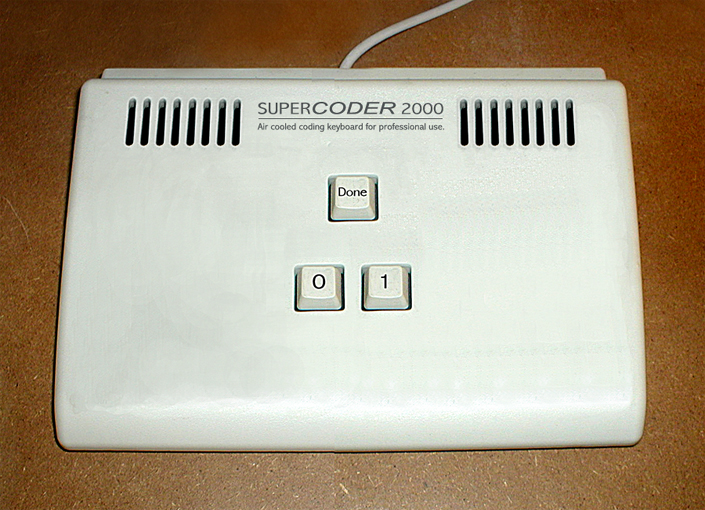
A keyboard exclusively for programming in binary

Air-cooled coding keyboard for professional use

(*) It is technically possible to put a Sound Blaster 1.0/1.5 (CMS+Adlib), Bank Street Music Writer card (essentially a PC Mockingboard), LAPC-1, IBM Music Feature Card, and SCC-1 into a Tandy 1000-series computer if you take the cover and metal frontplate off to allow room for the full-length cards and configure the LAPC-1 and SCC-1 so that they don’t share the same port and IRQ.   That’s six technologies — the seventh is the Tandy 1000 itself, with its SN76496 3-voice squawker.  If I had a 5161 expansion unit for the 5160, I could become more evil — it adds 7 additional ISA slots to the 7 already in the 5160.  I’d lose the 3-voice Tandy, but the additional slots would allow for adding up to three more IBM Music feature cards and an additional Sound Blaster Pro 2.0, and maybe even an additional SCC-1 (I’d have to check what settings it supports).  But I don’t have a 5161; they’re ludicrously difficult to find complete.  And besides, once you have two SCC-1s in a machine, what is the point of driving anything else?

Posted in Demoscene, Digital Video, Gaming, Lifehacks, MindCandy, MobyGames, Programming, Vintage Computing | 11 Comments »

Save Ferris

Posted by Trixter on October 21, 2009

Well, a group of us are collecting money to buy Ferris Bueller a new kidney. They run about 50 g’s, so if you wouldn’t mind helping out:

Yeah, he’s getting me out of Summer School.

Shit, I hope he doesn’t die. I can’t handle summer school.

Posted in Vintage Computing | 1 Comment »